

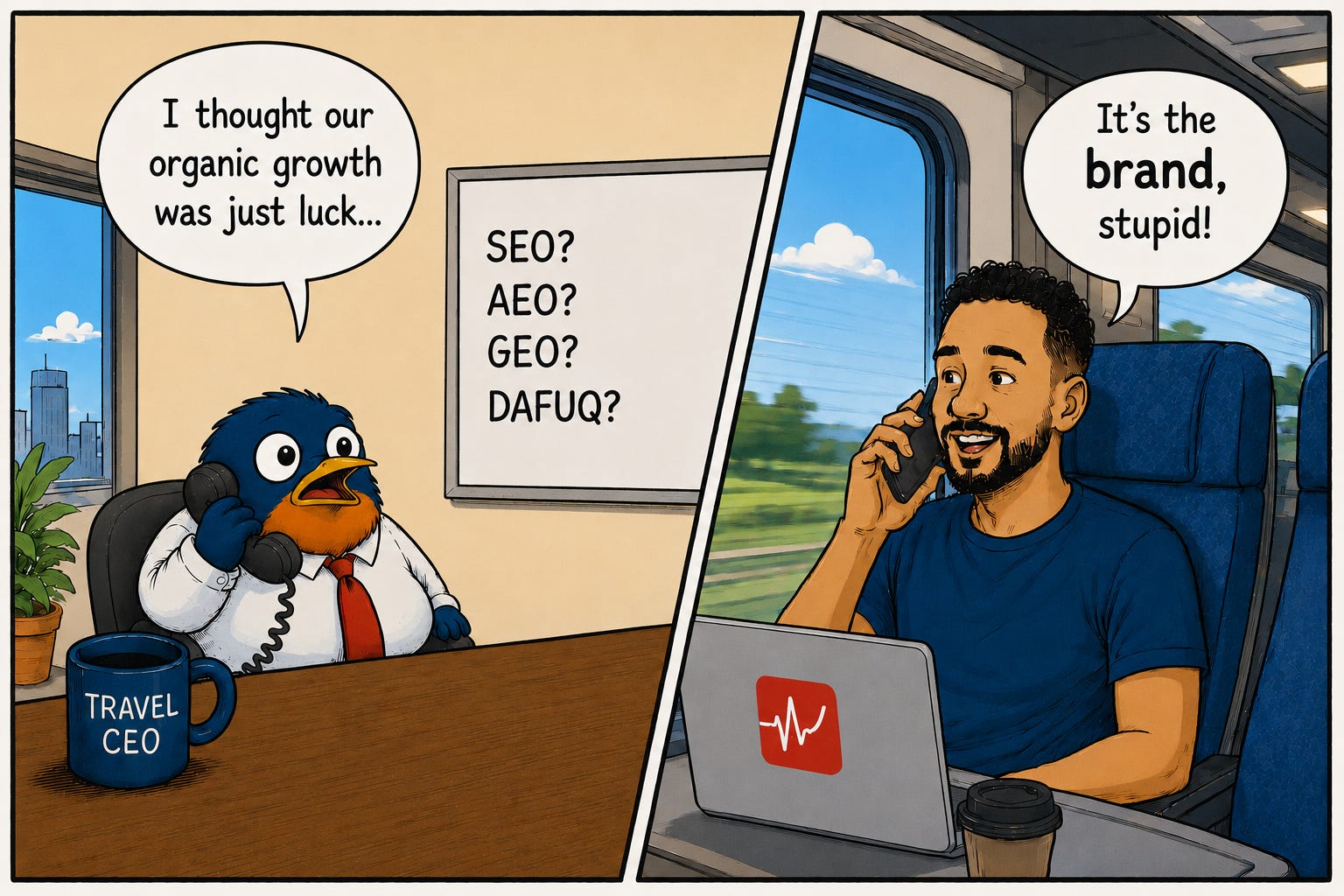
“It’s the brand, stupid!” is my rendition of the legendary catchphrase “It’s the economy, stupid!” coined by U.S. political advisor James Carville during the 1992 U.S. presidential campaign for Bill Clinton. I never imagined that 20 years after meeting Carville as a U.S. political science student, and after 12 years leading SEO at HolidayCheck and KAYAK, I’d be quoting him in a newsletter about SEO for the travel industry.
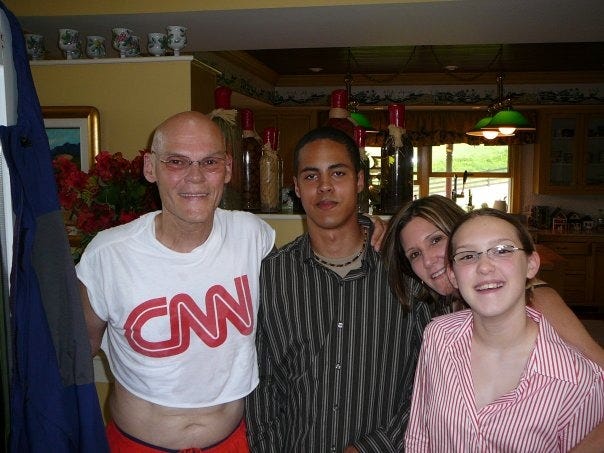
But here I am, and just as I think it’s fair to say that Carville’s argument remains the ultimate political truth - that voters consistently prioritize who they think they can trust with their wallets, I also think we can argue with confidence to relevant stakeholders in travel that ultimately, search engines and the LLMs that retrieve and synthesize search results seek to prioritize promoting the brands in their rankings and answers who they think travelers trust the most with their wallets. But how do they know who travelers trust? Brand 👏🏽 signals 👏🏽.
When I talk about brand signals, I’m not talking about your logo, brand guidelines, tone-of-voice or anything like that. I’m talking about measurable outputs and clear evidence that travelers are actually picking you by your name:
Navigational searches for your name (e.g. “Airbnb”)
Brand + modifier searches (e.g. “KAYAK flights from NYC to Frankfurt”)
Branded prompts in AI search (e.g. “find me a Marriott in Berlin for two nights with parking”)
Mentions across the internet that clearly associate your name with a travel topic
And just so folks don't get it twisted: brand signals alone won't move the needle on growing revenue from travel SEO/GEO. You still need travel content that's crawlable, indexable, retrievable and relevant, and a travel product that actually satisfies the intent behind a user’s search or prompt and makes them want to mention your brand name in their future searches and prompts. John Mueller, a Senior Search Analyst at Google, put it this way years ago, summarized by Barry Schwartz, a prominent SEO journalist: "make your site the best so Google would be embarrassed not to rank it well". That's the foundation, and brand is what you build on top of it.
Now that we’re clear, in the travel industry, brand signals have only grown in importance over the years in Classic Search (think your traditional 10 blue links) , and this is also turning out to be true in the AI answer engines that fan a single prompt out into many related searches and stitch together the results into summaries, despite some suggestions that AI doesn't care about the biggest travel brands.
🧳 Packing list
🛫 Takeoffaways
If you read only one thing: In travel, brand demand looks like the biggest driver of both Classic SEO and AI SEO performance: rank the brands analyzed by brand demand and by organic traffic and the two lists mostly match (rank correlation +0.72), and the same goes for AI visibility (+0.61). Suppliers (hotels, airlines, car rental agencies) are special because the trip actually ends with them: all nine suppliers analyzed score 88 to 92 on AI visibility and no OTA or metasearch brand gets past 83. Google is increasingly taking metasearch’s job for itself, with its own flights pages 19 times more visible than at the beginning of 2023 on brand demand that barely moved. Only two brands grew brand demand, Classic Search traffic and AI visibility at the same time in the period analyzed, Hilton and IHG, both hotel chains. Booking.com and Skyscanner didn’t gain on all three, but both grew brand demand a lot, 62% and 36%, and each gained on one more layer: Booking.com in AI visibility, Skyscanner in Classic Search traffic.
Where to invest
Brand marketing: Invest in advertising (brand marketing, PR etc.) and anything else that gets more people typing your brand name in Classic Search and AI Search, on its own, with a keyword like “{brand} {city},” or inside a prompt like “find me a {brand} hotel in {city} for two nights with parking.” Then make sure you’ve got relevant landing pages ready to show up for those searches and prompts.
Competitor mention benchmarking: Use third-party SEO/GEO visibility tools like Ahrefs, Semrush, Profound and Peec AI to see which sites and AI answers mention your competitors but not you, then go after those mentions with PR, partnerships or advertising.
Loyalty: Leverage where possible features like points and having a mobile app to get more people looking for your brand name again between trips, not just when they're booking. That repeated brand search is what keeps feeding suppliers and other brands that have such features in both Classic Search and AI Search.
Trend marketing: Build a system that’s always detecting emerging trends and owning the sticky ones before competitors do, using tools like Google Trends, SparkToro, Alertmouse, Similarweb and Finchling. That way, you can always be turning relevant fleeting moments into brand demand that lasts.
Task completion: Let the traveler complete as much of their task as possible on your site. For suppliers and OTAs that’s the booking. For metasearch it’s facilitated booking where you can, plus price alerts and trip management once they’ve booked. Every hand-off to another site lets that site satisfy the intent the user came with, and it increases the chance they come back by typing that other site’s name instead of yours. Finish the job yourself and the name they most likely type next time is yours, which is the brand demand signal both Classic Search and AI Search appear to reward.
How to run it
Experimentation: Always be testing. Never be satisfied with the status quo, because that’s how you get beaten. A feature or tactic is only as good as the time it takes a competitor to do the exact same thing. So run A/B and split tests wherever it makes sense, to find out fastest what actually moves the needle on engagement, conversions and repeat visitors, and grow brand searches off the back of that.
Traveler experience
Personalization: Make the user feel special by tailoring your site to them. Show deals based on where they actually are, show their recent searches so they can pick up where they left off, and use what they filtered, searched and booked last time to make the next trip easier to plan and book. Make them feel at home on your site, like it’s their space. That earns repeat visits, and repeat visits mean more searches for your brand.
🩺 Pulse Check: key trends in Classic Search and AI Search for travel
For this Travel Search Pulse Checkup, I analyzed 20 of the largest travel websites in the U.S. in 3 categories (Suppliers, OTAs, Metasearch) across flights, hotels, car rentals and vacation rentals to see which content performs best in Classic Search and AI Search:
The Data
Brand demand: Google Trends. Why Trends and not search volume from an SEO tool? Because it’s Google’s own sample of real searches, I can put every brand on the same 0 to 100 scale, and for names that also mean something else (Budget, Enterprise, Hertz, Hopper, KAYAK) it can track the brand as a thing rather than the word. The catch is that it’s relative, not absolute, so I set Expedia to 100 and read everyone else against that. Why Expedia? It’s a big travel name that isn’t also a regular word, so its Trends line is clean. HomeToGo’s name sits below Google Trends’ reporting threshold, so the rank correlations later on are on the other 19 brands.
Classic Search:
Semrush organic traffic for each individual site (Marriott, Booking.com, Skyscanner and so on).
Sistrix visibility for the category trend lines (suppliers vs. OTAs vs. metasearch), because it goes back weekly to 2023. It’s built from rankings across a big, representative keyword set, with each ranking weighted by position and search volume and added up into one number.
Why both? Sistrix scores how visible a site is in Google’s rankings, which is helpful to get a trend line and for something like Google’s own travel landing pages. Semrush estimates actual traffic and shows which pages and which kinds of searches it comes from, which is helpful when asking what a specific brand did.
AI Search: Semrush's AI visibility score, which is how often a brand gets mentioned in AI answers compared with its competitors, across prompts Semrush pulls from AI search data.
Time ranges:
The trend charts run from January 2023 to August 2026. The AI charts start in September 2025, because that’s when Semrush’s AI score begins.
When I compare a brand “then” vs. “now,” then is March 2022 to February 2023, the last full year before Google started testing AI answers in results (SGE launched May 2023), and now is September 2025 to August 2026. Both are full-year averages, so seasonality doesn’t mess up the comparison.
Page-level numbers are single months, February 2023 vs. August 2026, because that’s how Semrush reports them.
1: Suppliers have the most resilient model in travel search
Alright, what’s the data saying? It’s saying suppliers clearly stand out vs. OTAs and metasearch on brand demand, Classic Search and AI Search visibility.
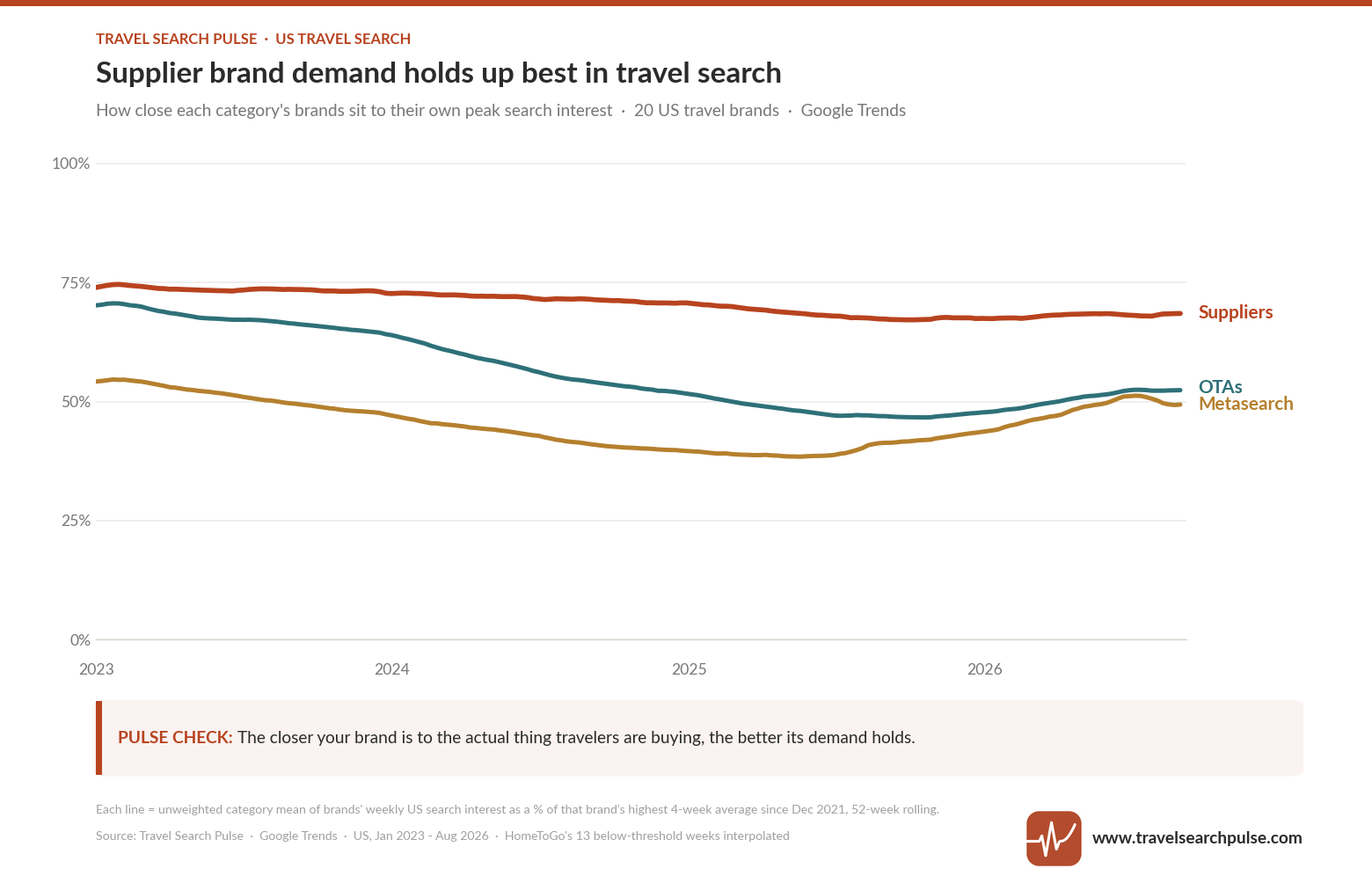
Check out the suppliers line and you’ll see it barely moves and that they’ve held up strongest on brand demand the whole way through. OTAs and metasearch, on the other hand, have mostly declined since 2023 and have only just started to rebound in Google Trends.
So how does that translate over to performance in Classic Search and AI Search?
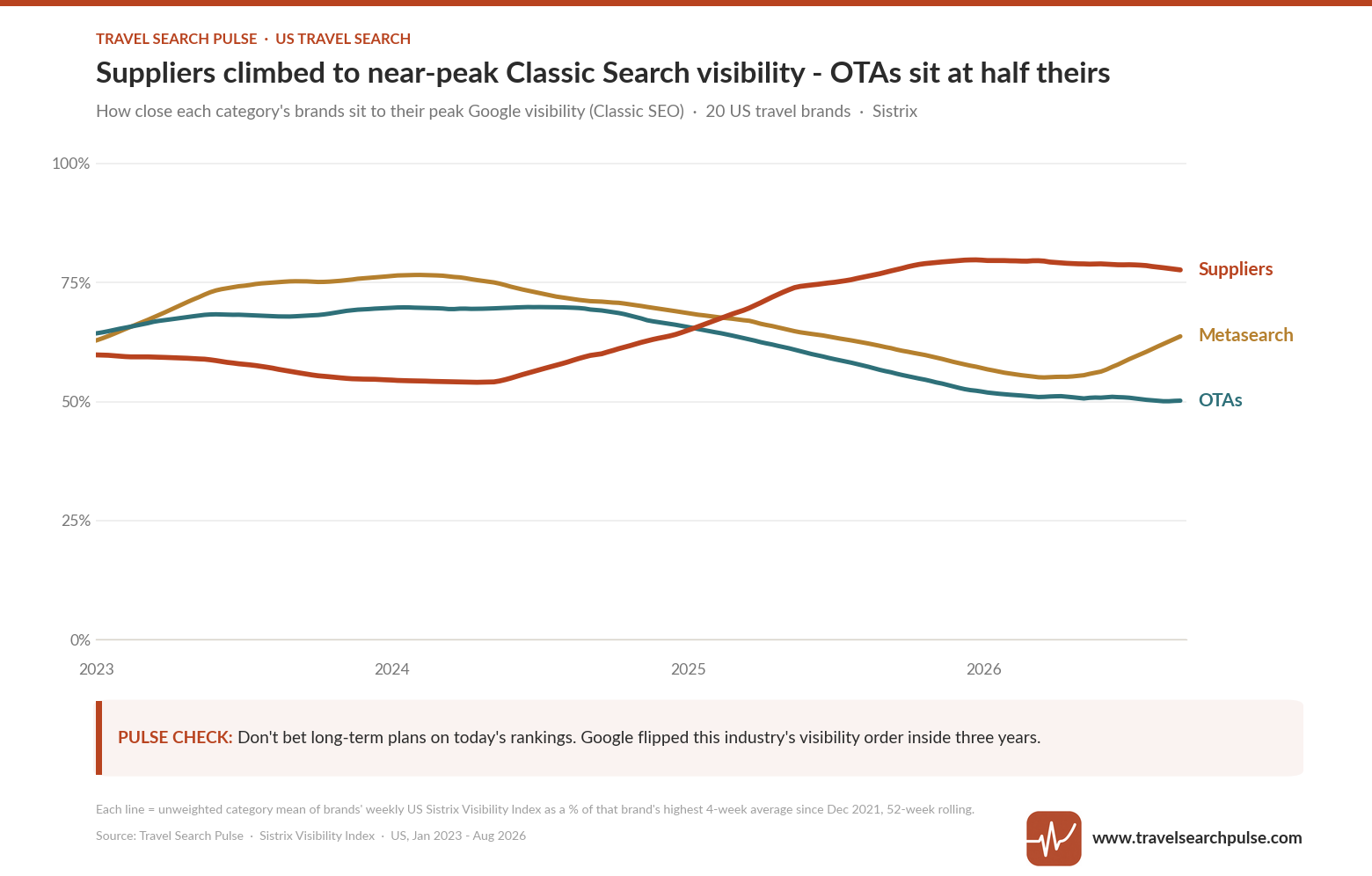
When we look at the same date range for Classic Search, we not only see that suppliers held up best, we see that they grew. Google essentially flipped which category of travel brands it favors within the three years analyzed: suppliers went from the bottom line on this chart to the top, while OTAs and metasearch mostly declined. And 13 core algorithm updates in the same time period suggest Google changed which category it most trusts to “present helpful and reliable results for searchers.” seoClarity saw the same pattern around the latest core update, in May 2026: direct travel brands up 8%, aggregators down 11%.
You can see the flip more clearly in a single kind of search: Using Semrush, I checked out U.S. searches for “flights to [city]” and “cheap flights to [city]” for six big U.S. city destinations in February 2023 vs. August 2026, and the chart below shows who ranks in the top 10 positions. This chart looks at whoever ranked, separate from the 20 brands analyzed in the rest of this essay, because you can’t look at a search result and ignore half of it. In 2023, the OTAs and metasearch sites owned both search types. Fast forward to 2026 and the more general search goes to the suppliers (airlines), but when you throw in the word “cheap” in front of it, comparison sites still hold half of the rankings.
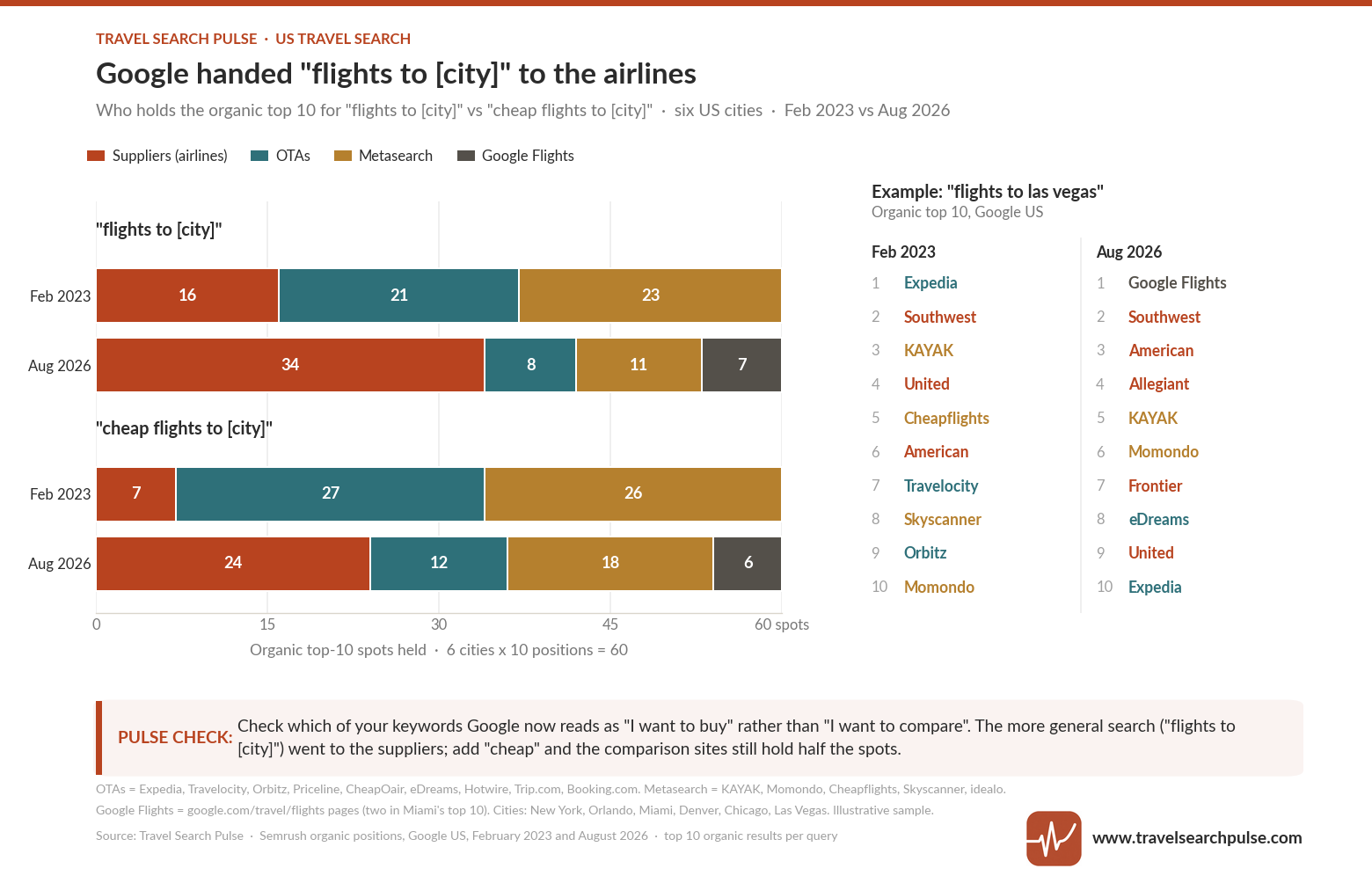
As you can see to the right of the chart in the before-and-after table for “flights to las vegas”, Expedia went from #1 to #10 and airlines now make up most of the top five rankings, owning position #2, #3 and #4. Think it’s fair to say here that Google now reads “flights to las vegas” more as “I want to buy” and “cheap flights to las vegas” more as “I want to compare.” The other key observation here is that Google Flights seems to have come out of nowhere to rank in the top 10 for all six cities, ranking #1 for four of them, but we’ll talk more about that in a bit.
What about in AI search?
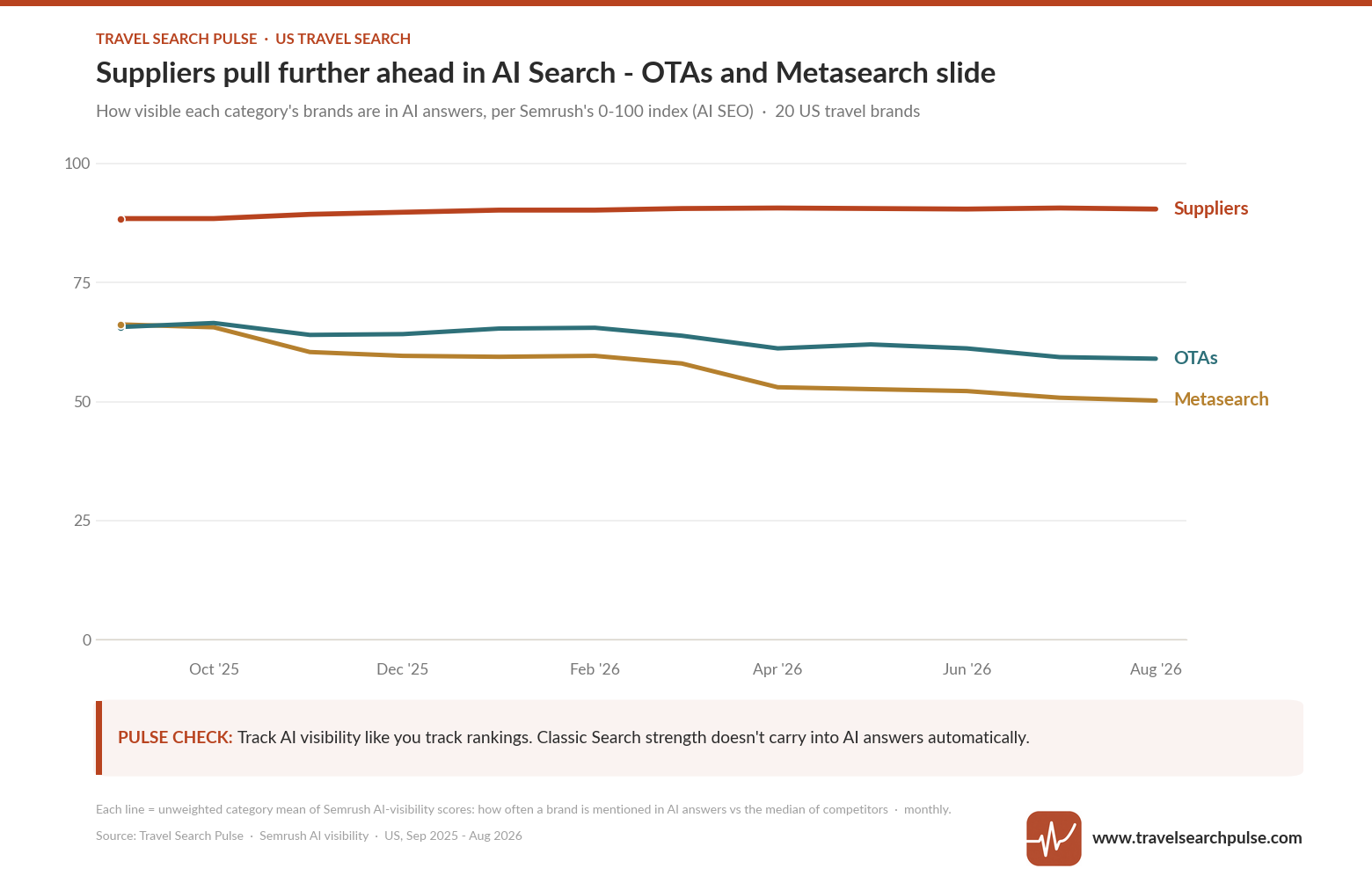
AI answers pretty much tell the same story as Classic Search and brand demand. Suppliers get mentioned the most vs. OTAs and metasearch and that gap appears to be widening over time.
Why Suppliers?
Suppliers own the actual thing you’re buying, so people tend to search for supplier brands across the whole trip:
Booking the trip
Checking loyalty points
Check-in
The app
Changing a reservation
Customer service
That’s a recurring thing, and it happens between trips too.
OTAs and metasearch, on the other hand, tend to earn a search during the research and planning phase, before you actually book anything. Once you’ve booked, you tend to stop searching for them. This is where having a loyalty program (Bonvoy, Honors, SkyMiles) gets interesting, because it locks in a habit where travelers come back and book with the same brand. Booking.com’s Genius program is the OTA version of the same idea. Otherwise, intermediaries just have fewer reasons to get searched for between trips.
Then there’s AI, which makes the whole story even more interesting, because it threatens exactly the price comparison step that made OTAs and metasearch really sticky, while it can’t disintermediate suppliers that still own the actual room, seat and rental car at the end of the day.
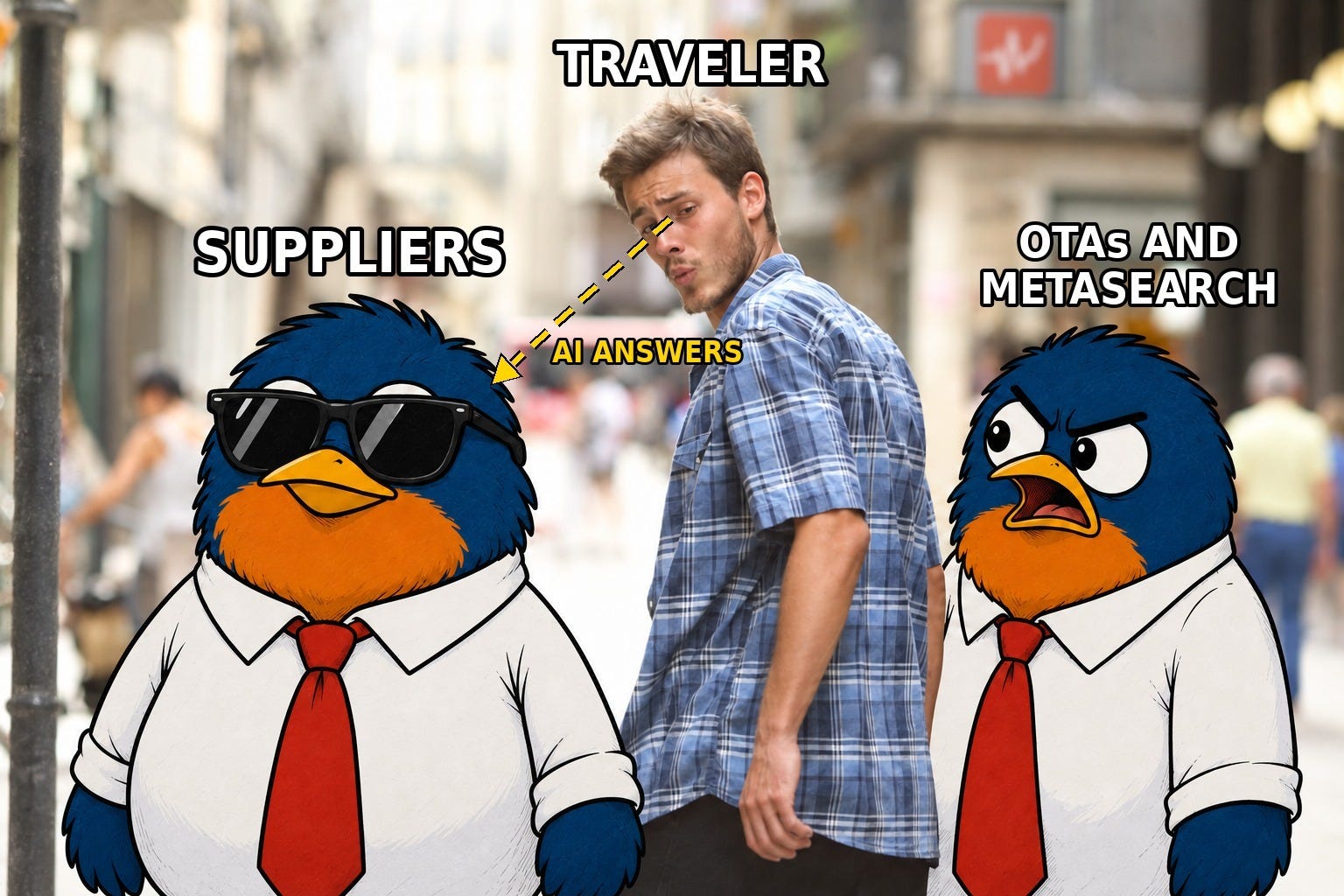
AI answers do the comparison now, and they mostly point at suppliers.
A quick detour: what this looks like first-hand from a traveler POV
Now, personally, I’ve mostly had good experiences booking trips via OTAs and metasearch sites (I mostly use Booking.com because their free cancellation features are awesome and KAYAK because I generally like their UX vs. other sites, even before they employed me), but just this summer, I’ve had to deal first-hand with two of the very real downsides of booking with an intermediary vs. directly with a supplier.
#1 - Limited Customer Service
I booked a Discover Airlines flight to Corfu, Greece departing August 21st for my family through Booking.com, where their flight bookings are processed in partnership with yet another OTA, Gotogate, which is owned by the Etraveli Group. However, I needed to update a name on the flight ticket:
July 9 - I requested the name update via Discover Airlines, and they redirected me back to Booking.com, saying that this is where I bought the ticket, so this is where I must get it updated.
July 10 - I requested the name update via Booking’s customer service/help center and on the same day, they informed me it was “being processed.”
August 1 - When I followed up on the status of the update, Booking’s customer service agent told me not to worry and that it would be settled before our August 21st departure.
August 11
When I followed up on the status of the update, a different customer service agent from Booking told me they couldn’t guarantee anything would be updated, that it was dependent on a response from the airline, and suggested that I consider canceling and buying a new ticket at my own expense.
I called customer service of Discover Airlines, and they informed me that they never received the name change request from Booking, and that they’ve had this same experience previously with other passengers booking through the OTA.
I canceled the flight via Booking, and rebooked directly with the airline.
In the end, I lost some money, but more importantly, I didn’t lose my family summer trip thanks to booking directly with the supplier. What’s wild to me though is that all of that took over 30 days to do.
For the second leg of that same trip I had a flight with Condor Airlines, who I also had to ask to update the name on the flight ticket:
July 9 - I requested the name update via Condor Airlines.
July 11 - The name on the ticket was successfully updated.
Final outcomes:
OTA: 30+ days after initial customer service request ending with unsuccessful ticket update and booking cancellation
Airline: 2 days after initial customer service request ending with successful ticket update
Make it make sense. Who do you think I’m booking my flight with next time?
#2 - Increased Risk of Being Scammed
I booked a stay via Booking.com at the Only YOU Hotel Málaga which is owned by the Palladium Hotel Group. Next thing I know, I’m receiving the following confusing message directly via WhatsApp on my phone asking me to click on what I eventually realized was likely a phishing link:
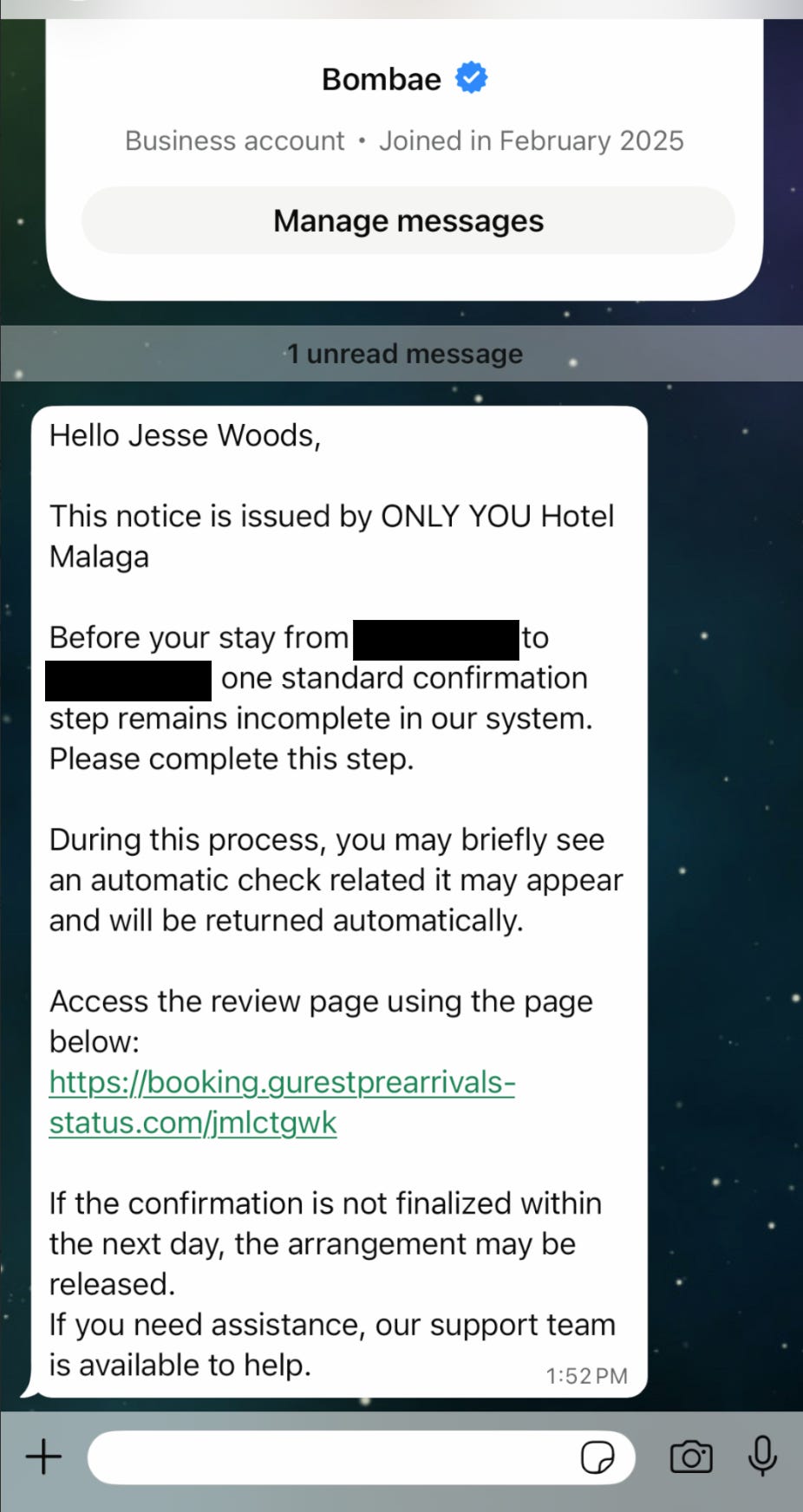
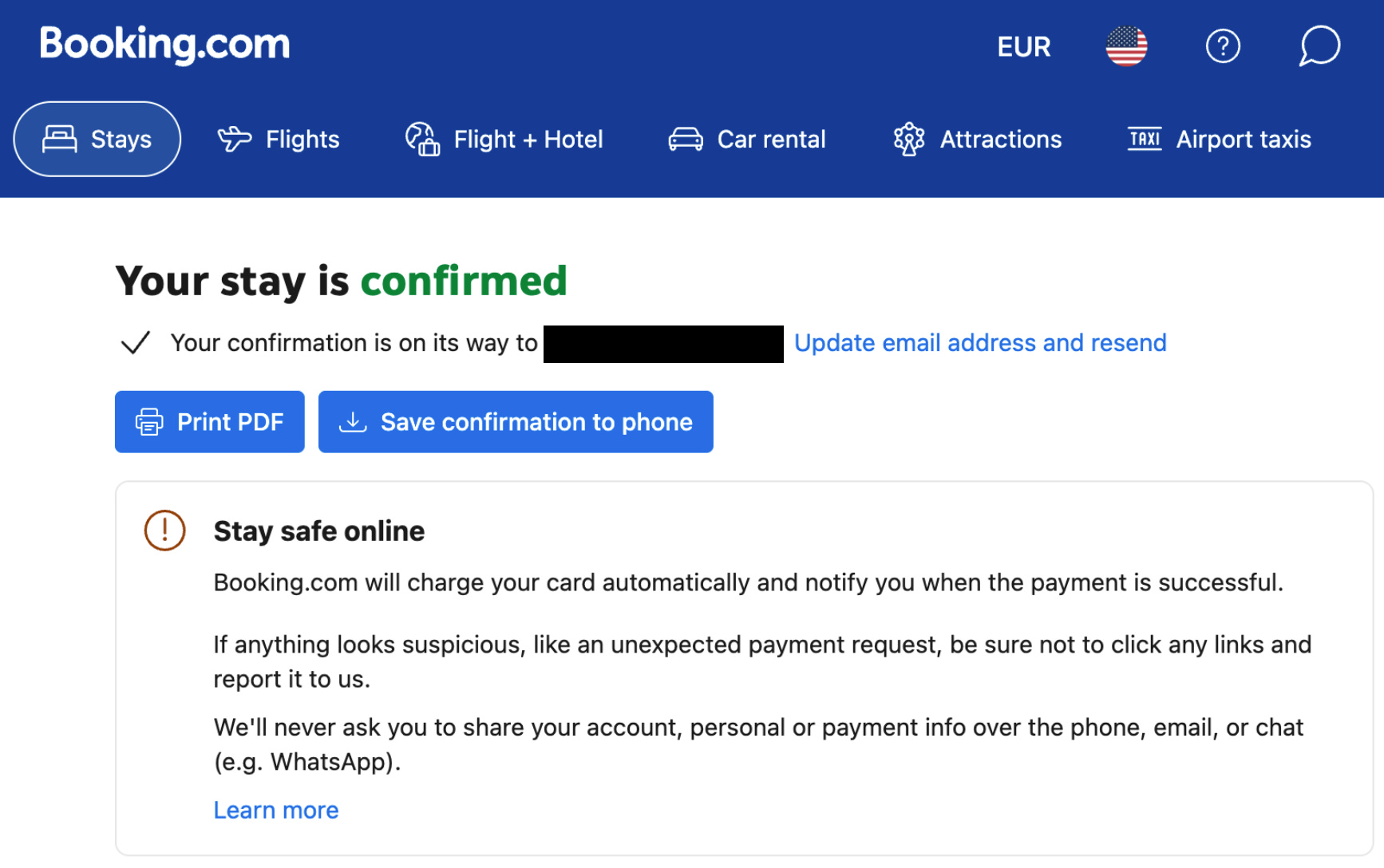
Thankfully, Booking.com encourages caution against such messages directly on their site and in the email confirmation they send you after you book a hotel, but after I reported and blocked the message, I got 2 more just like it from 2 different numbers, which was super annoying.
Since the attempt to scam me happened 3 times, I raised the issue directly with the hotel’s Data Privacy team, and they came back to me and told me that a 3rd party provider’s reservation system was compromised and that I shouldn’t open messages that don’t come from a Palladium Hotel Group account.
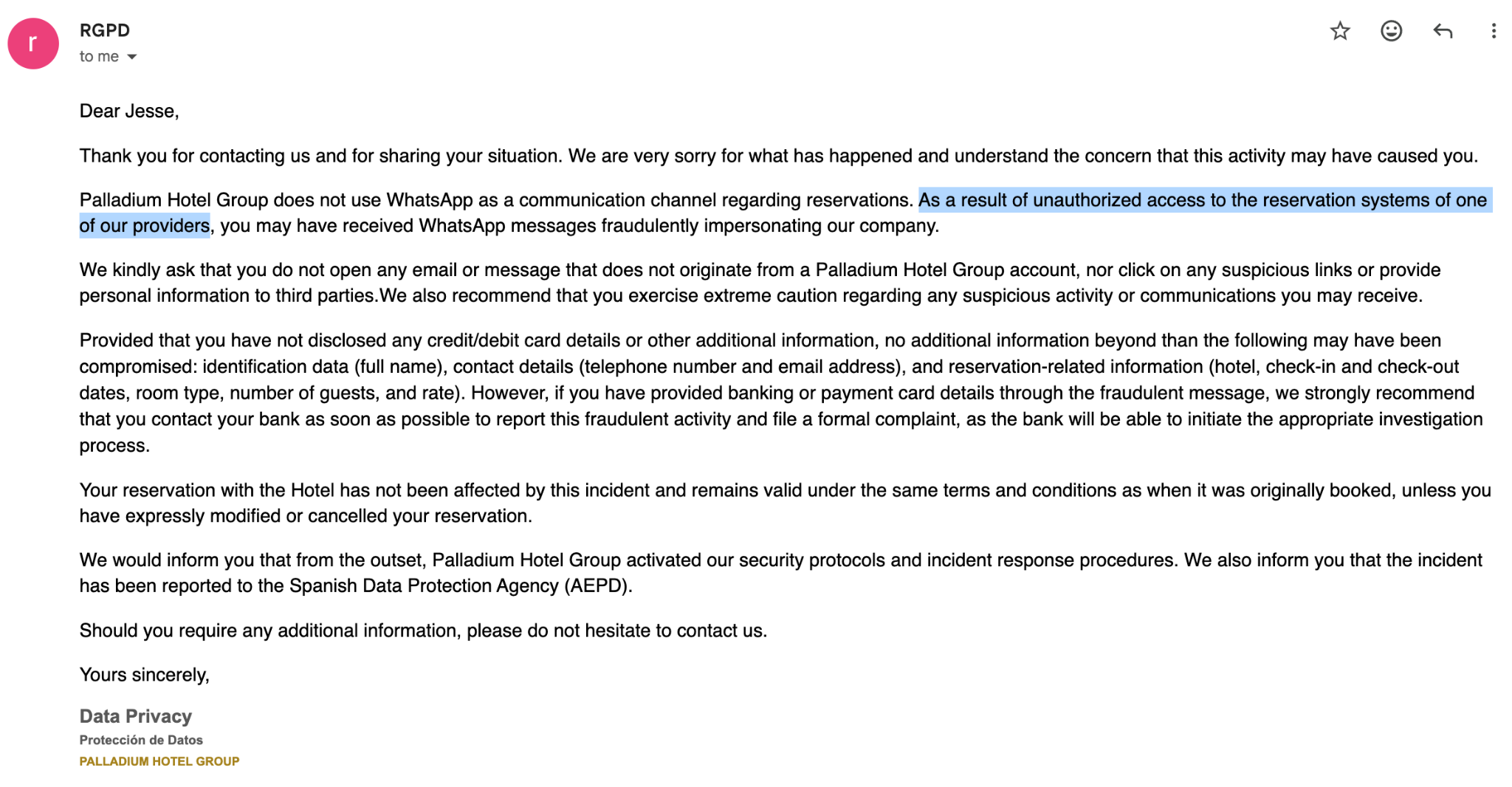
And this is the second time this year I’ve had this experience. It’s not just me either: security researchers have been tracking a wave of scams that run through compromised Booking.com hotel accounts since late 2024. Based on this, who do you think I’m more likely to book my hotel with next time? Via the OTA or directly with the hotel?
Although they haven’t happened often, I do hate the hassle and unnecessary stress that come with such setbacks, and they definitely have left a bad taste in my mouth. As a result, increasingly I just use metasearch and OTA sites as research tools and then I’ll leave and then directly go to and book on the supplier’s site for peace of mind. At first I thought that was just a me thing, but perhaps it’s a more common experience that’s also increasingly being reflected in Classic Search rankings and AI Search visibility.
2: The elephant in the room: Google rewarding itself
So what’s going on with Google in all of this? First of all, they’ve got their own flight metasearch product directly above all flight search results, plus in more recent years they’re also dramatically “organically” ranking their own travel landing pages higher vs. other travel websites, in particular for flight searches, no matter the category (airline vs. OTA vs. metasearch).
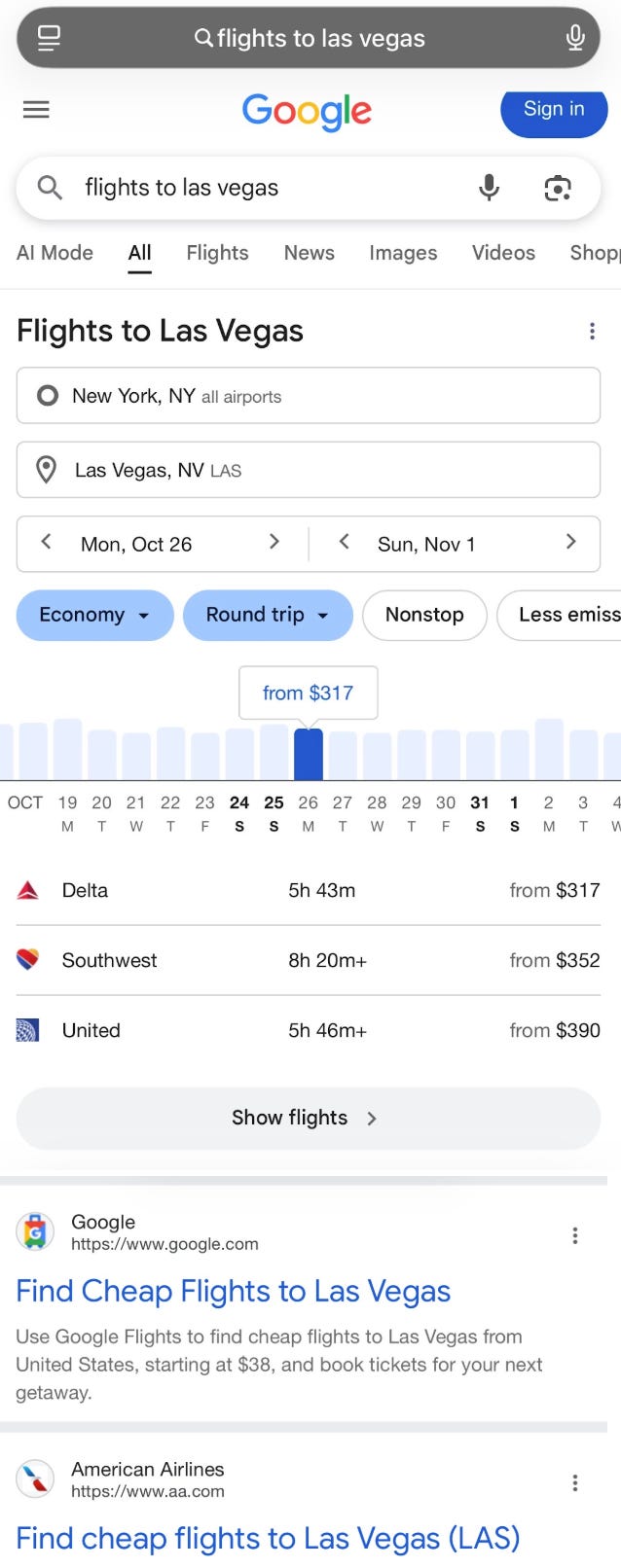
The problem here is that it looks like they didn’t win these rankings by earning demand like everybody else has to in search, but rather it looks like they did it by just giving themselves the win, I suspect because they own the game anyways, and there’s no reliable effective European Commission equivalent in the U.S. to properly referee said game. The European Commission, for its part, fined Google €460M in July 2026 for giving its own services, including hotels and transport, preferential treatment over third parties in Google Search. That’s why I look at Google separately and don’t include it in the 20-brand analysis.
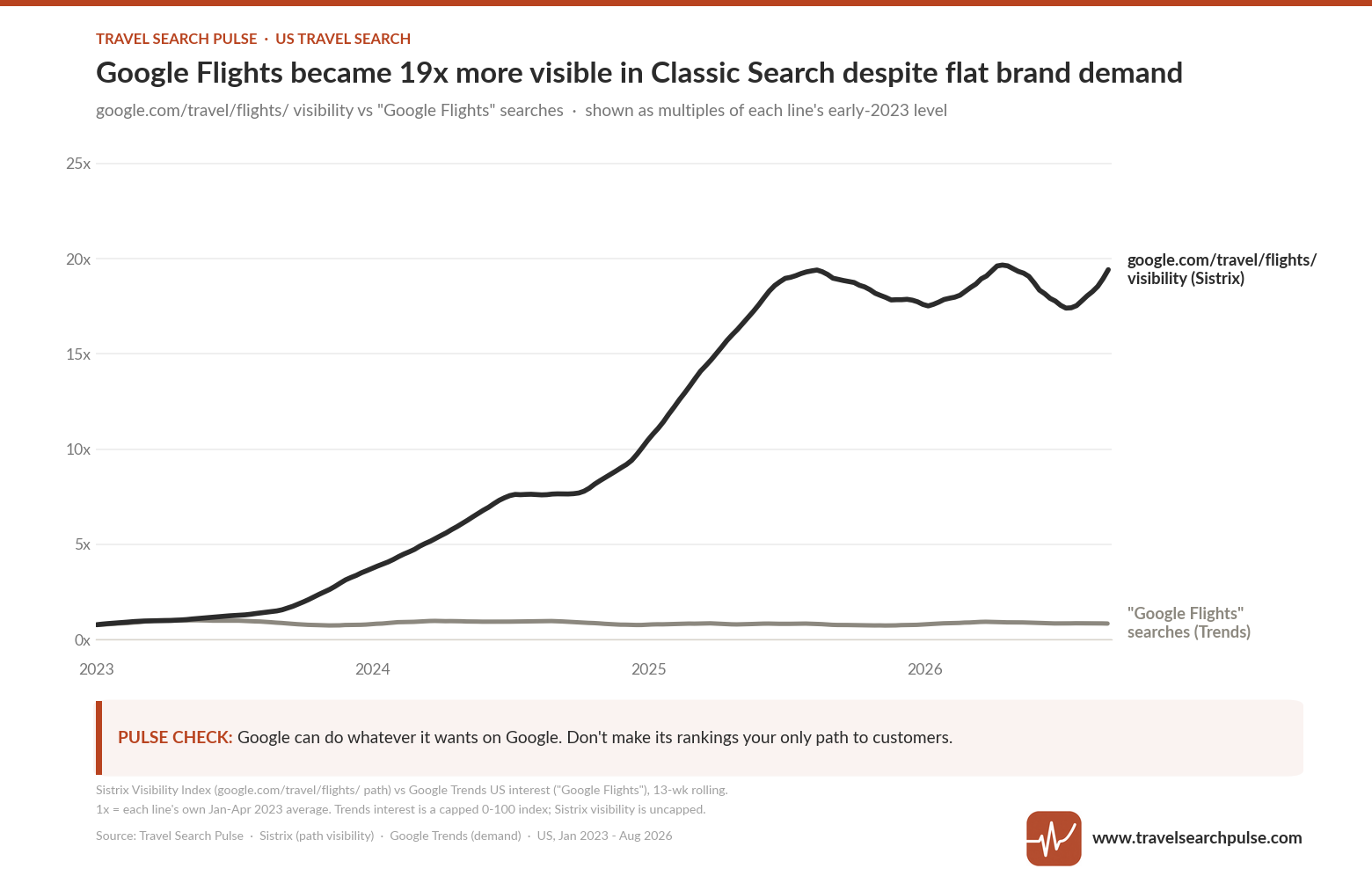
Google’s own flight subfolder of landing pages is now 19 times more visible in U.S. Google organic results than it was at the beginning of 2023, even though searches for “Google Flights” didn’t grow anywhere near that during that time. So if nobody was asking for more “Google Flights”, what happened? Well, it looks like Google just gave itself more visibility, I guess because who’s going to stop them 🤷🏽♂️?
Compare the search visibility rise of Google Flights pages with the five metasearch brands in the chart below (KAYAK, Skyscanner, Tripadvisor, HomeToGo, Trivago) and the point kind of makes itself, right?
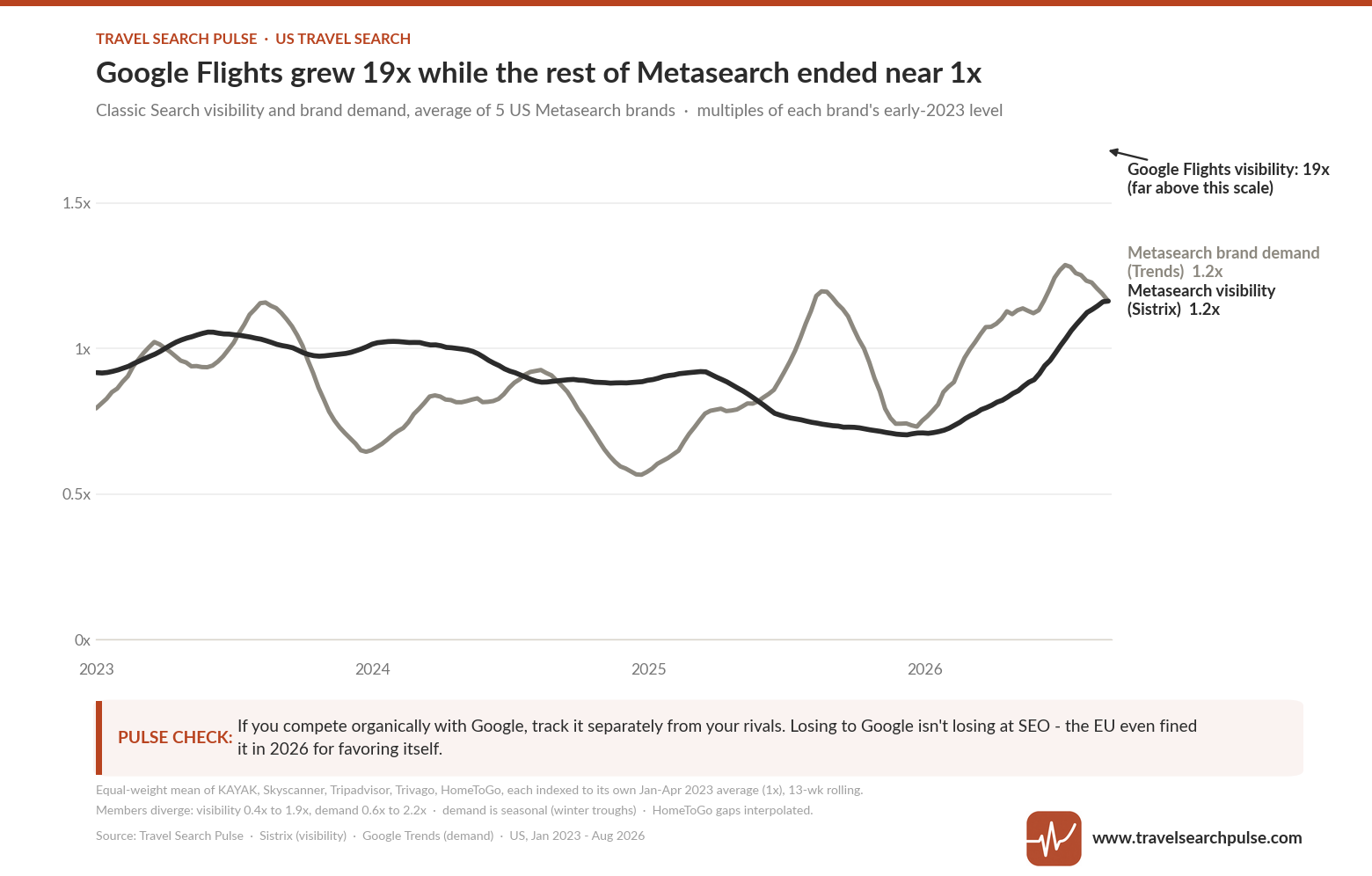
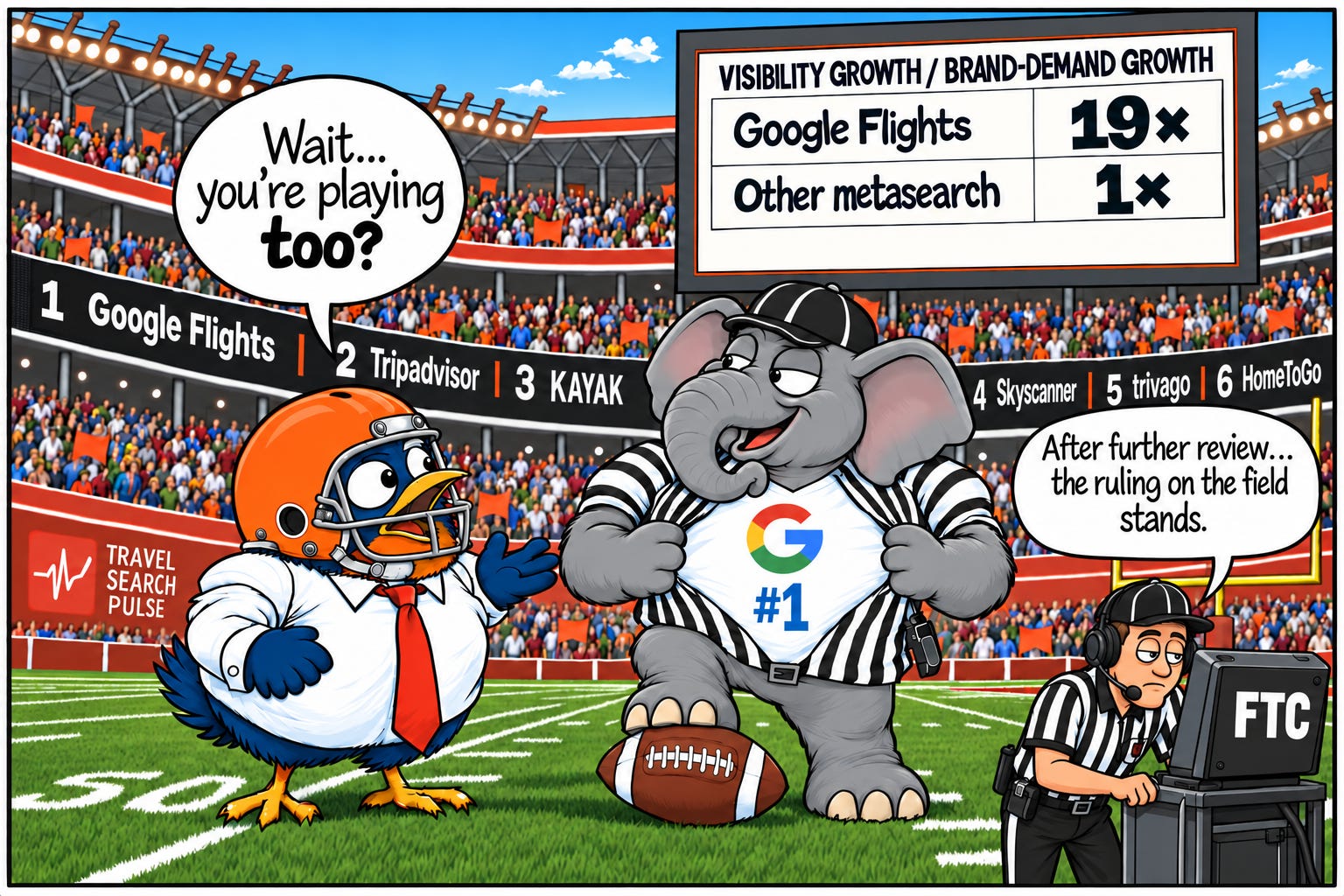
Those metasearch brands’ visibility basically moved with their brand demand, both ending around 1.2x over the same time period, while Google Flights’ visibility grew 19x on brand demand that barely moved. In that context, I find it hard to argue that Google is actually competing and earning those rankings, and easier to argue that they’re just assigning them to themselves, that the ranking referee just decided to put a jersey on and take over the travel game.
Another quick detour: what this looked like first-hand from an SEO POV
Something I first observed back in May 2024: Google had started ranking its own “flights to [region]” pages like the one for “flights to India” above pages like https://www.cheapflights.com/flights-to-india/ (disclosure: Cheapflights is a KAYAK brand). Only problem is that Google’s flights to region pages at that time were ranking despite having zero content about the region on them, whereas pages like the India region flights page on Cheapflights actually were about flights to India and showed deals on flights to India. But you can see what I observed back then for yourself because a snapshot of the page from back then is still available on Wayback Machine:
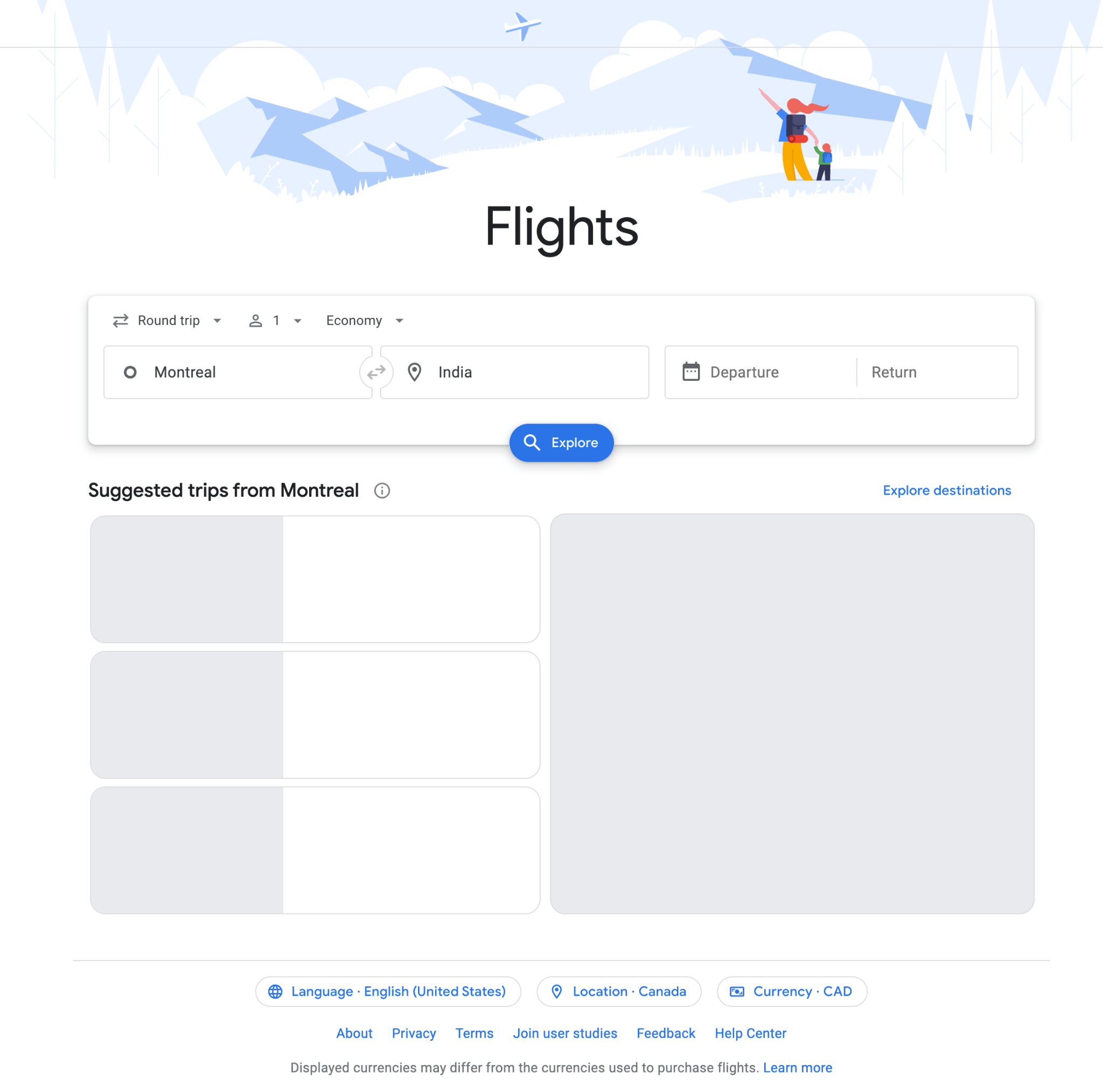
Google’s “flights to India” page, May 2024 (Wayback Machine)
There’s a search box on the page with “India” pre-filled as the destination, and that’s the first and last thing about India that you see on the page. Aside from the search form there’s just a section of deals on suggested flights from Montreal to popular destinations - the Wayback Machine snapshot doesn’t capture the rendered deals here and the info button doesn’t respond to clicks on the snapshot, but you can confirm that the section is about trips to generic popular destinations by inspecting the snapshot html.
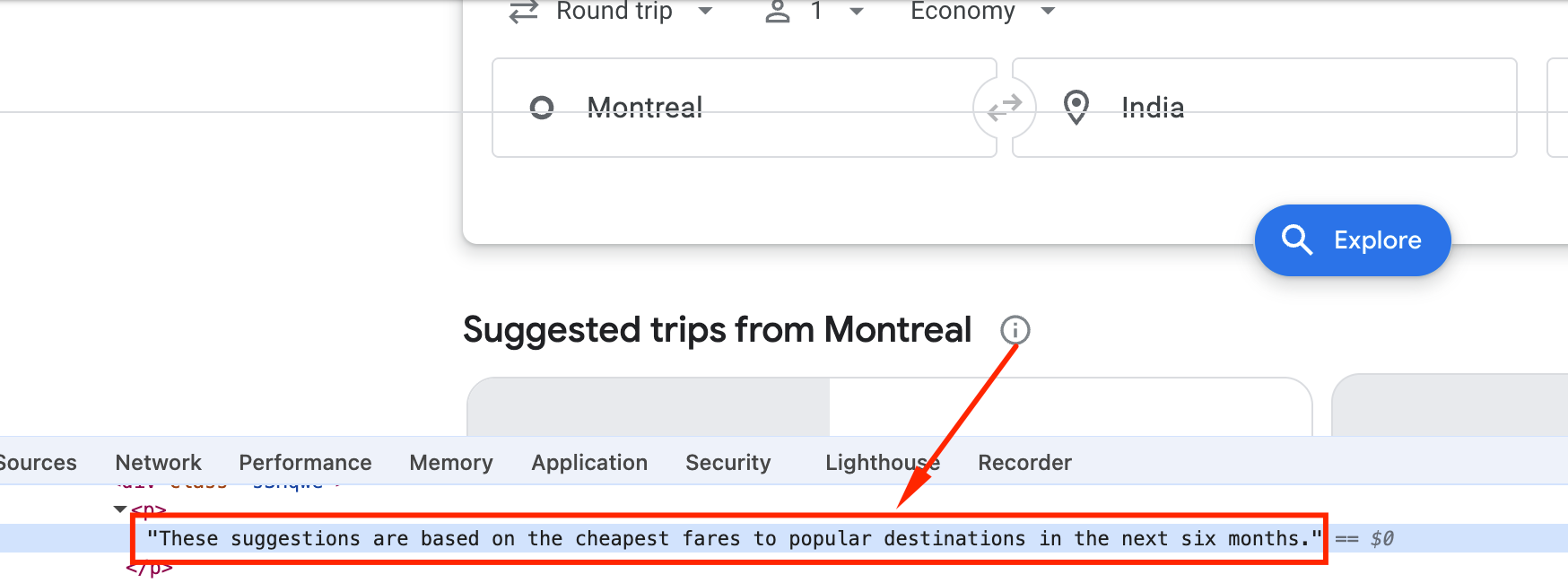
The snapshot’s HTML: “cheapest fares to popular destinations.” Nothing about India.
If you remove that one instance of the word “India” on the page, you’d have no idea this landing page had anything to do with India other than the meta title. If any other travel brand built that, it would be labeled by Google as a doorway page and demoted in rankings.

Anyways, back then when I called this out to Google’s VP of Engineering for Search, the answer I ultimately got back from Google was that they apply the same organic ranking algorithm to their own pages as to everybody else’s. I know what you’re thinking: “But Jesse, how could such an irrelevant landing page outrank landing pages that are actually relevant and from known brands?” I asked the same question, and the explanation I received for why this page, and all of their other Google region flight pages like it were indexed and ranking at all despite irrelevant content was…..cue drum roll… “it was a bug.”
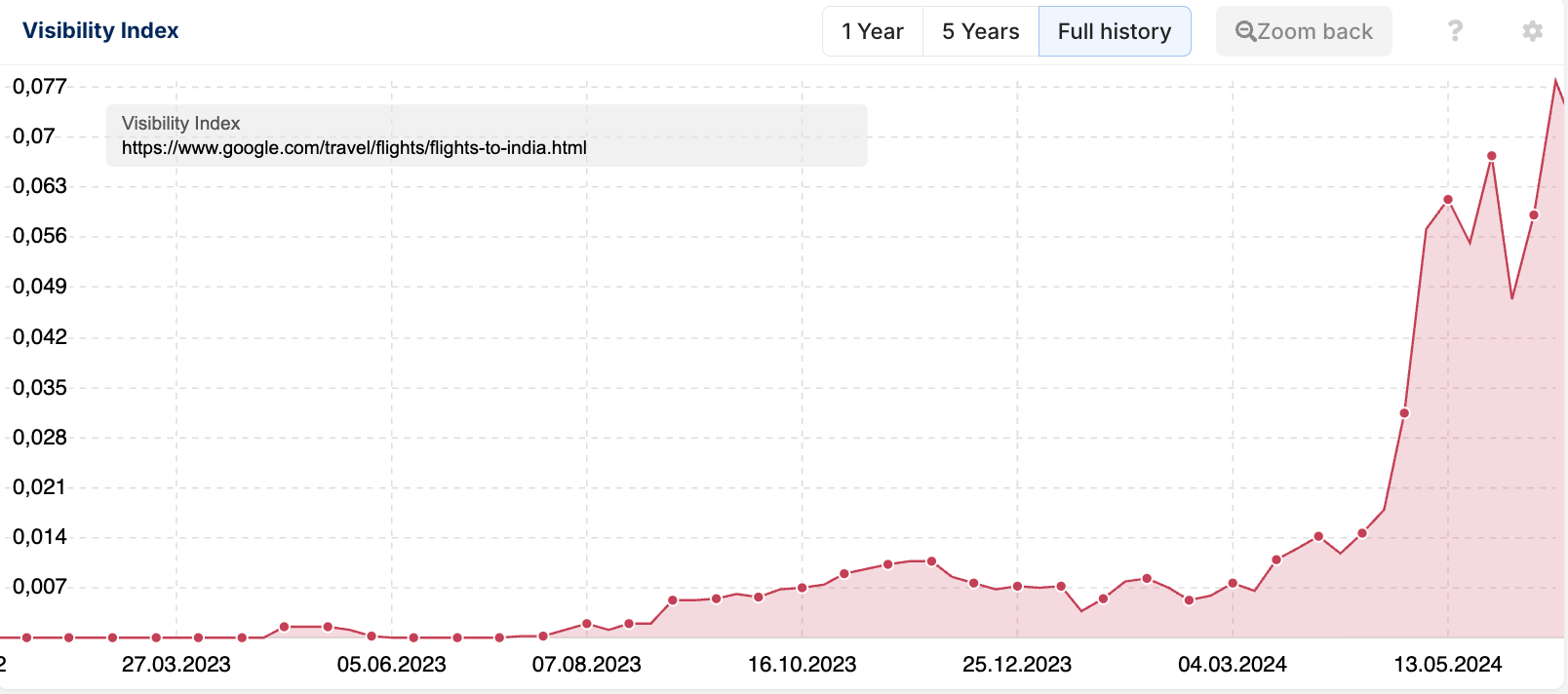
Sistrix visibility index for Google’s irrelevant “flights to India” page, Jan 2023 to May 2024, when I called it out to them
A few days later after I was told it was a bug, Google put out pages that look more like this that are more relevant and on a new url (old url still exists but canonicals to the new one). By October of the same year, Search Engine Journal reported that Google Travel had 750K+ landing pages indexed in the U.S., and fast forward to today and they now dominate in organic rankings, in particular for flights searches. A bug that allows organic visibility to skyrocket on landing pages with irrelevant content with no consequence is one hell of a bug 😂.
3: The strongest brands in each travel category are the ones mostly coming out on top in both Classic and AI search
Now that we’ve acknowledged the elephant in the room, let’s zoom in on the 20 real players analyzed in these categories to see whether having a stronger brand actually helps predict who comes out on top in Classic and AI search.
In Classic Search, it appears that brand demand and organic traffic mostly move together. If you list and order the brands by how many people searched for their name from highest to lowest, and then make another list ordered the same way but by organic traffic, you’ll find that the two lists mostly match (rank correlation +0.72, whereby 1 equals identical lists and 0 means no relationship). Take out Semrush’s navigational-intent traffic (for most of these brands, that’s people typing the brand name) and it drops to +0.48, still the same direction, just weaker. Tripadvisor’s long tail is most of that gap, more on that below.
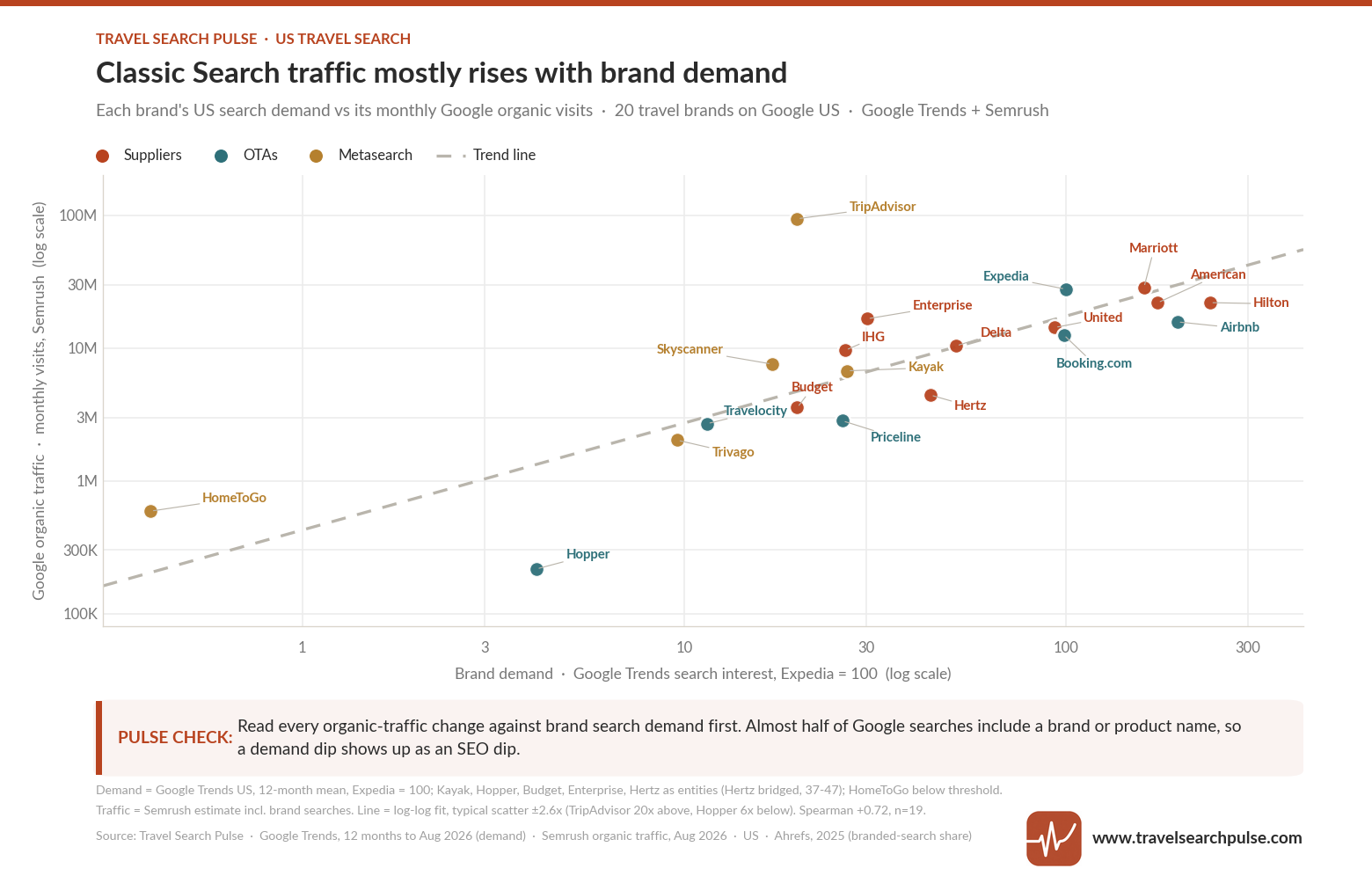
In the chart we see:
From the bottom left end going right that HomeToGo and Trivago (metasearch) and Travelocity (OTA) have lower brand demand and lower organic traffic relative to the other brands analyzed.
All the way on the other side, on the top right of the chart we’ve got the suppliers Marriott, American and Hilton, which have a lot of both (brand demand + organic traffic). The hotel chains and airlines as a group sit up high on both axes relative to the other brands analyzed. The car rental brands are the exception among suppliers, sitting mid-pack.
Up in that same crowd we find three of the OTAs, Airbnb, Expedia and Booking.com, holding their own against the suppliers on both axes. The other three OTAs (Priceline, Travelocity, Hopper) sit low, which is why the OTA group as a whole lands below the suppliers even though its biggest brands don’t.
And then there’s the rest of the metasearch brands, which mostly sit in the lower middle on both axes vs. the analyzed OTA and supplier brands.
There are definitely some interesting exceptions to the headline here too which deserve acknowledgement, as correlation doesn’t necessarily mean causation and the bigger picture of SEO is obviously more nuanced than just strong brand = strong SEO performance:
Tripadvisor sits high above the line with the most organic traffic of all the brands despite having significantly lower brand demand vs. brands like Expedia. Why? It has a massive database of individual user reviews, forum posts and even landing pages for the photos that come with those individual user reviews, which gives it 5M+ pages ranking in Google’s top 100 (Semrush) vs. for example Expedia, which has just over 900K. The result is tons of very long-tail content and ~98% non-branded organic traffic, with ~60% of those keywords having only informational intent, or navigational intent for some other brand entirely (e.g. people searching “Texas Roadhouse” and landing on a Tripadvisor review of it). So most of Tripadvisor’s SEO traffic isn’t really theirs to keep (more on that later).
Hopper’s site, on the other hand, sits way below the line, with low organic traffic vs. the other brands despite real brand demand. People typing “hopper” make up 85% of what little U.S. organic traffic it does get (Semrush’s branded-keyword filter). A big part of it is that their core product lives in the mobile app. You can still see prices and book trips on the website, but they serve their best deals inside the app, and they even position themselves on their own about us page as the “award-winning mobile app.” They’ve also only got 2.6K pages ranking anywhere in Google’s top 100 search results, and they sell flights, but don’t even have, for example, a ‘flights to Las Vegas’ page showing up in Google. Compare that to another OTA, Travelocity, which is 82% non-branded with ~300K pages ranking, and pulls in about 1.7M non-branded visits on top of its brand traffic. Key difference: Travelocity built out landing pages at scale. It looks like Hopper uses every marketing channel except SEO to funnel people into app installs, and from the outside it feels like a missed opportunity to use their brand strength to grow app installs through SEO as well.
Skyscanner and Enterprise are also interesting for sitting a bit above the line. Skyscanner grew its U.S. brand demand 36% and tripled the keywords it ranks for, from 905K to 2.6M between Feb 2023 and Aug 2026 (Semrush), in part by adding new pages, both within existing verticals like flights, hotels and cars and in newer subfolders such as /destinations/. Enterprise is interesting because Hertz shows greater search interest in Google Trends, yet Enterprise sits well above it on organic traffic. The clearest difference we can see is the backlink profile: ~38K referring domains to Hertz’s 31K and Budget’s 23K (Semrush). More on Skyscanner in the What’s landing section later on.
If those exceptions make you skeptical about the link between brand demand and organic performance, don’t take my word for it: Ahrefs even found that about half of all Google searches contain a brand name (46%, across 150M+ US queries), so when fewer people type your brand name, your “SEO” falls with it, regardless of what your rankings did.
In AI Search, AI visibility also mostly follows brand demand (rank correlation +0.61). What stands out more than the correlation itself is how answer engines appear to treat suppliers compared to OTAs and metasearch.
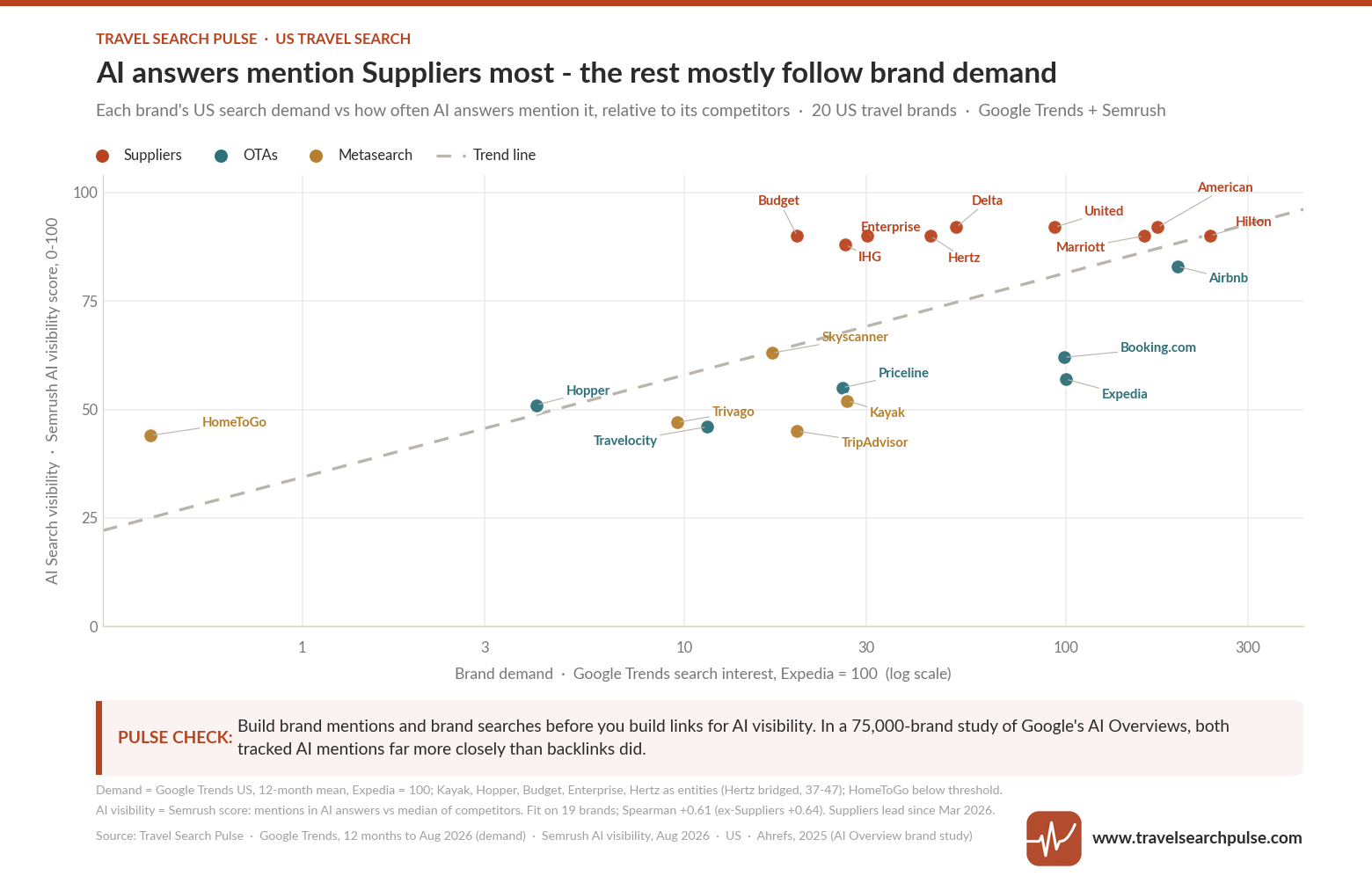
As you can see in the chart, the suppliers are all bunched together at the top, even the ones with modest demand, which suggests there’s a category effect happening here. That makes sense if you think about how answer engines sort of do the comparison job themselves already, so they’re more likely to just suggest the supplier that an OTA or metasearch site would have suggested to you anyways, whereas Classic Search still sends you to an OTA or metasearch site for a lot of that.
If you take the suppliers out of the chart, the correlation between brand demand and AI visibility still holds (rank correlation +0.64 across the ten intermediaries with brand demand data), and within the intermediary categories, the stronger brand mostly wins, for example:
Airbnb > Booking.com > Priceline
Skyscanner > Trivago
Seth Borko, Head of Skift Research, was already suggesting the direction we see things going in on the Skift Travel Podcast back in June, before I’d pulled any data for this essay. It was actually part of what inspired me to dig deeper into this. Now that we’ve got the data, we see that all nine of the suppliers analyzed score 88 to 92 on AI visibility and no OTA or metasearch brand gets past Airbnb’s 83 (every supplier has scored above every non-supplier since March 2026), so I think it’s fair to say the data backs up Borko’s point. Here’s how he put it:
“Everyone’s worried about AI visibility right now. The ultimate form of AI visibility is, book me a hotel in this brand new city I’ve never been to. Wait, by the way, it has to be Hilton. [...] Once the customer says that, you’re golden. You just have to get them to say that.”
In that context, his pitch on the podcast for Hilton’s next campaign was: not Stop Clicking Around, but go to whatever chat you want, and add “with Hilton.” Given everything we’ve talked about so far, it makes a lot of sense that if travelers are already putting your brand in a lot of their prompts to begin with, that’s a signal to the answer engines that you’re probably worth mentioning to other folks with travel-related prompts too.
If you still aren’t convinced: Ahrefs analyzed 75,000 brands, and found that brand mentions across the internet were the strongest signal for being shown in Google’s AI Overviews (correlation of +0.66), and even branded search volume (+0.39) outperformed backlinks (+0.22).
A last detour: what Google’s leaked search algorithm documents reveal about brand signals
You may remember back in 2024, about 2.5K pages leaked from Google’s Content Warehouse API documentation, which two of the most respected people in SEO, Mike King and Rand Fishkin spent a lot of time reviewing and wrote about at the time, highlighting how important it reveals that brand signals are. I think three things in particular from that leak and Rand and Mike’s takeaways are interesting here:
siteAuthority - a site-level score Google maintains, despite in the past saying they don’t have anything like a website authority score. Google hasn’t come out and shared exactly how it’s calculated, but since it’s a score for the whole site as opposed to individual pages, I think it’s fair to say it works like a score for the brand behind the site, where a known brand carries it onto every page it puts out.
NavBoost - a system that ranks pages partly based on how people click. Google’s own VP of Search confirmed under oath in a DOJ antitrust trial that it exists and is “certainly a factor” (Trial transcript, Oct. 18, 2023, PM session, pp. 6404-6405), and a senior Google search engineer’s own résumé, referenced by Fishkin, called it “already one of Google’s strongest ranking signals.” People tend to click on names they already know and trust, so in that context it would make sense that every search+click for your brand feeds the click data that helps inform how much visibility Google gives you.
Entities - the leaked documents suggest Google keeps a record of each brand as an entity, a thing it knows about rather than just a word on a page (so it can tell Apple the company from apple the fruit), and gives that entity its own scores. This suggests that the brand itself is something Google scores, and it’s reasonable to assume what informs that score is searches for the brand, clicks on the brand and people talking about the brand, as opposed to only page optimizations.
Fishkin’s #1 big picture takeaway from the leaked documents was “Brand matters more than anything else,” and King, after listing everything in the documents that a site can be penalized for, concluded that it “boils down to making stellar content with strong user experience and building a brand, if we’re being honest.”
Alright, so from the data and leaked documentation, it looks like brand is a strong signal that helps feed performance of travel brands in both Classic and AI search, but that alone I think is only partially helpful and only one step of what we need to figure out here.
🛬 What’s landing? What’s working well in travel search for the brands that are being rewarded by search engines and LLMs?
When you put it all together, brand demand + Classic Search traffic + AI visibility, who’s actually coming out on top, and what are the biggest gainers actually doing to drive growth? I ranked all 20 brands based on all three areas combined to create the layered chart below. Quick note on the scoring first: on each of the three layers, first place gets 100 points and last place gets 5, and a brand’s score is just the three added up, so 300 is the best possible.
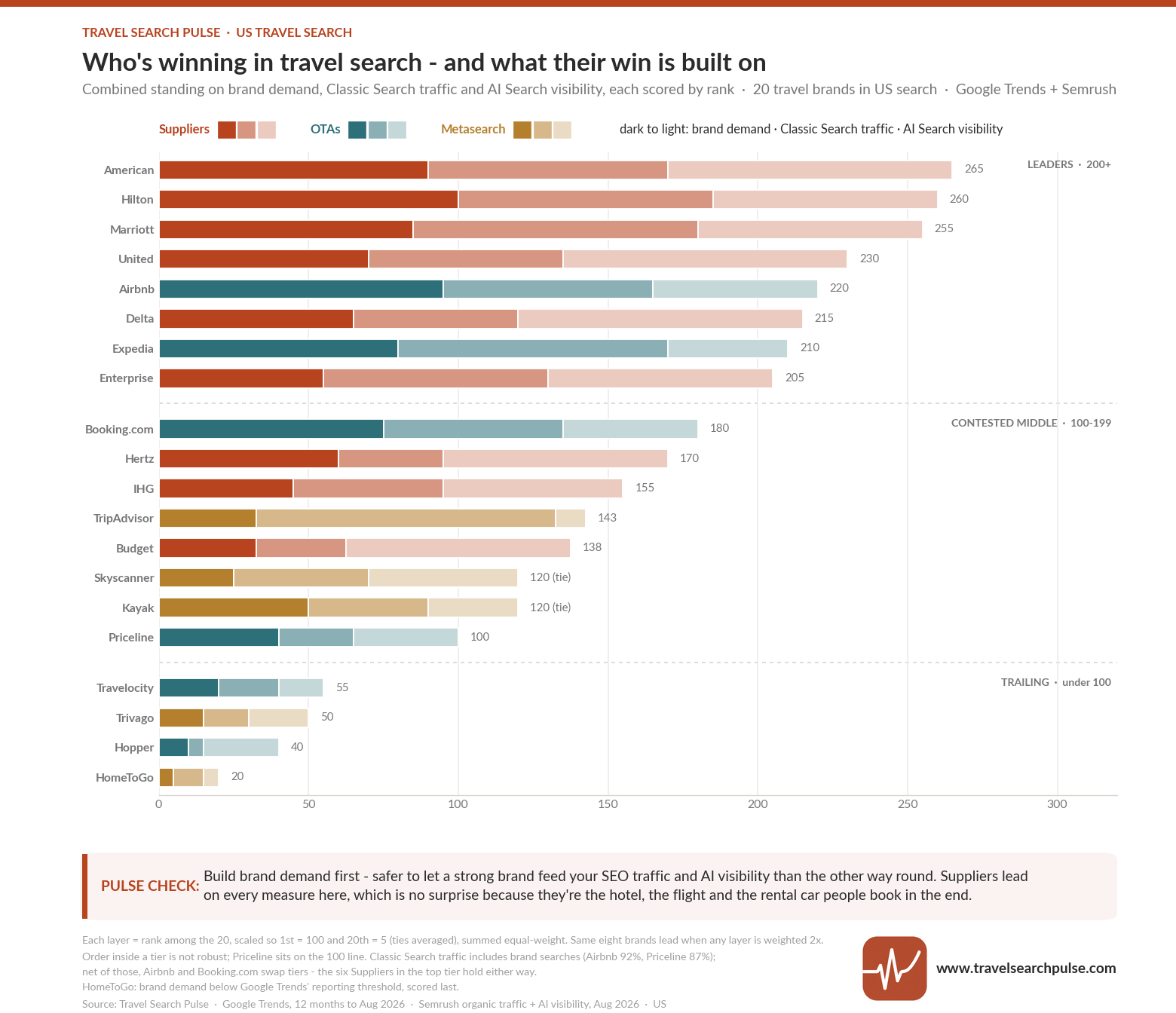
In the chart we see:
Leaders (200+): mostly suppliers, plus Airbnb and Expedia, both OTAs and the only intermediaries up there.
Contested middle (100 to 199): a mix of categories here with three suppliers, two OTAs and three metasearch brands.
Trailing (under 100): all intermediaries.
Airbnb’s spot up there near the top is partly its own name (92% of its organic traffic is people typing “Airbnb”). If you take that out, Airbnb and Booking.com swap tiers, but the six suppliers in the top tier hold their spots either way.
Suppliers as a category lead on every layer here, which is not a surprise at this point because we know they’re the hotel, the flight and the rental car people book in the end.
Assuming you’ve got a solid product and a competitive user experience figured out, I think it’s pretty fair to say based on all the data we’ve seen here that building brand demand first, as the foundation you grow your SEO performance on, makes a lot of sense. It’s most likely a more stable and reliable approach than trying to do it the other way around. That’s not saying you can’t grow with SEO alone. Tripadvisor’s 94M visits a month says you can, and the same goes for whoever fills the gaps that bigger brands leave open (see Hopper). It’s saying that at this scale, the traffic that comes with a brand name attached is the kind that holds up when the way people search changes.
Cool story, but I think who’s winning overall is less interesting than who has grown the most between the year before AI answers showed up in Google and the last 12 months (“then” vs. “now” recap: Mar ’22 - Feb ’23 vs. Sep ’25 - Aug ’26). And what have they done that’s feeding these gains? Here are the same 20 brands, in the same order as the previous chart, with how much each one moved on each layer:
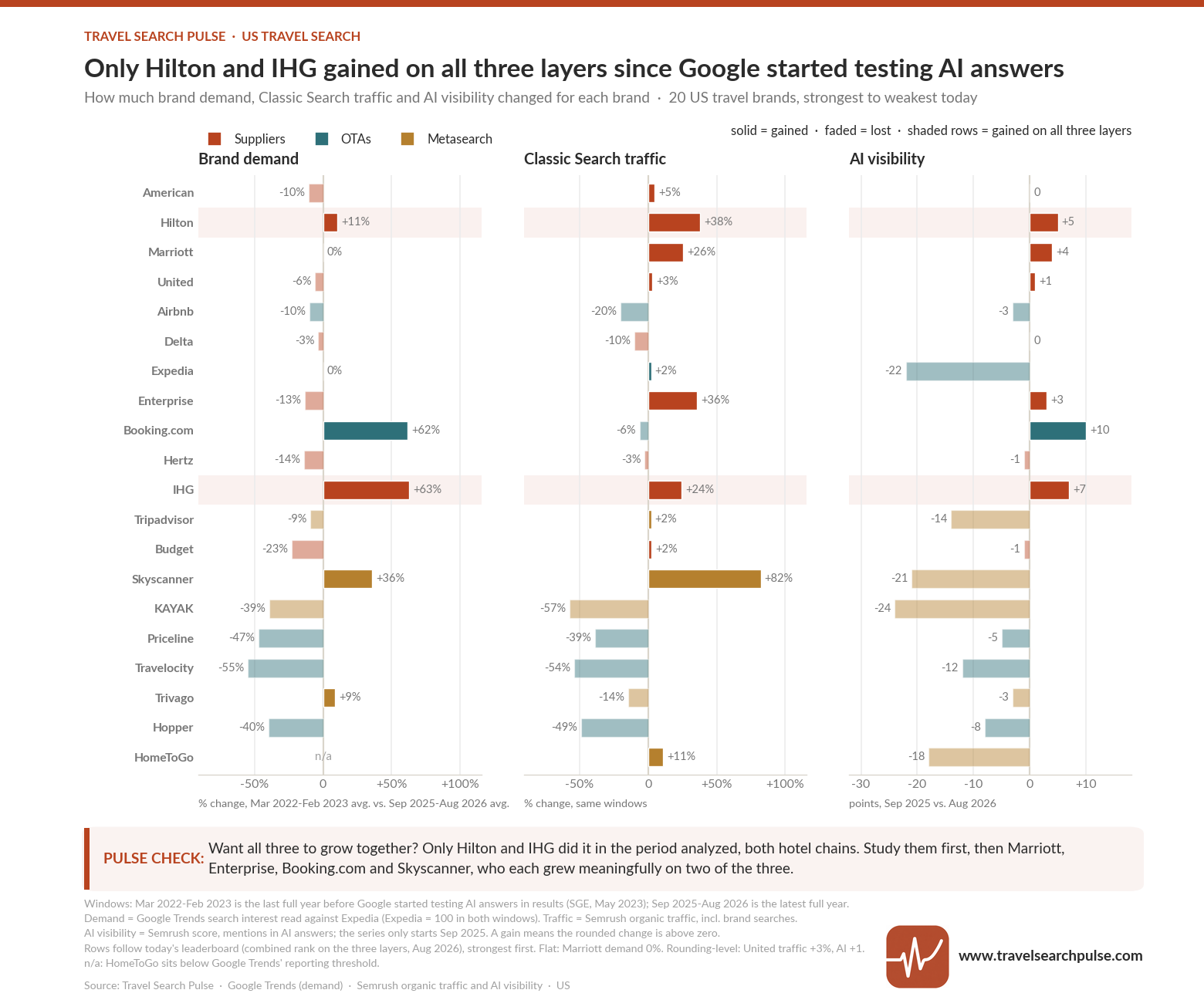
In the chart we see:
Brand demand shrank for most of the list. Only five brands grew it by more than 5%.
Suppliers mostly gained in Classic Search traffic, with Hilton, Enterprise, Marriott and IHG all up by about a quarter or more.
AI visibility split by category: every supplier gained or remained relatively flat, with IHG (+7) and Hilton (+5) up the most, and every intermediary saw losses except Booking.com, which had the biggest gain at +10.
Two brands gained on all three layers: IHG and Hilton. Both hotel chains.
Four more gained meaningfully on two of the three: Marriott, Enterprise, Booking.com and Skyscanner.
Let’s look closer at what the two that gained on all three did, IHG and Hilton, then Booking.com and Skyscanner. The numbers below use the same comparison periods as the chart above, and I also exported and looked at samples of Semrush’s U.S. keyword and prompt reports for August 2026, plus a Semrush export of 50K backlinks for each brand. One note on the prompts in the tables below: they use Semrush’s prompt wording and list the answer engines shown for each example. Semrush simplifies that wording, so these aren’t verbatim transcripts.
IHG - Supplier
Brand demand +63%, Classic Search traffic +24%, AI visibility 81 → 88.
What it did: relaunched loyalty as IHG One Rewards in 2022 and backed it with “Guest How You Guest”, its biggest loyalty campaign ever.
By the end of 2025, the program grew to more than 160M members. Two thirds of its room nights are now booked by members and 83% of room revenue comes through IHG-managed channels.
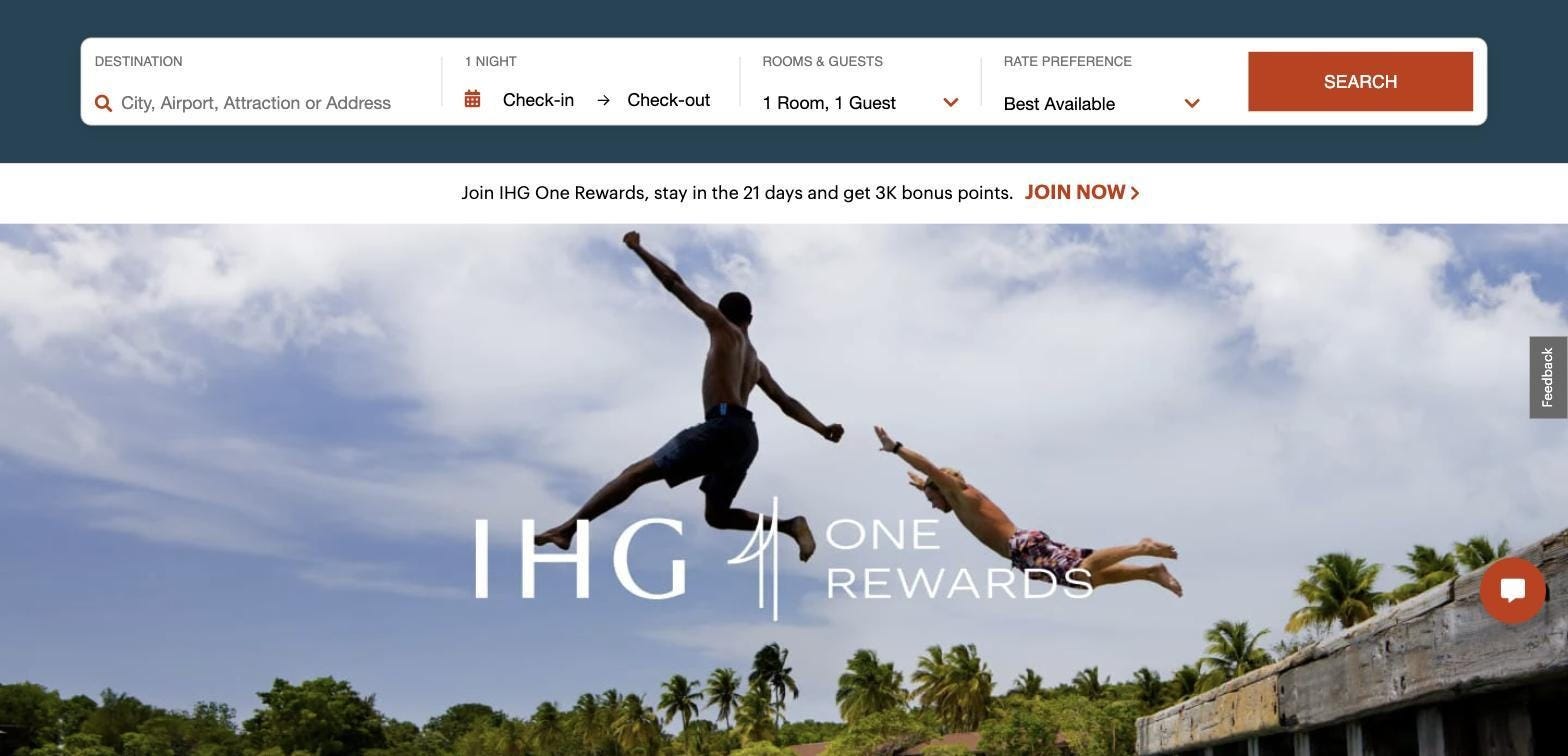
IHG One Rewards. Members 145M to 160M; two thirds of rooms now booked by members.
IHG also signed agreements for 366 hotels to switch to an IHG brand in 2024, up from 191 in 2023. It also rebuilt its booking flow so guests can pick room attributes and add-ons themselves, and says hotels see about $22 more per night when a guest buys one. More members + more hotels + more personalization = more people typing “IHG” in their searches and prompts.
Types of branded searches and prompts:
In Classic Search, I reviewed 27,152 branded keywords for ihg.com:
What’s noteworthy is that people also arrive through different hotel names owned by IHG (e.g. Holiday Inn Express). The credit card and login searches add something else, and you can see clearly from the rest of the search types that IHG’s relationship with travelers can continue between trips, through earning points and managing an account.
In AI Search, I reviewed 830 different prompts for ihg.com
Look at the comparison prompt. IHG is already in the question, but it still has to compete with Wyndham and Marriott. The credit-card question puts the brand into a decision that can outlast one trip. And the Iberostar prompt connects its points to a specific resort stay.
The company-travel and affiliate questions add another audience. These are people asking about using IHG for their business or working with it as a partner. That’s worth separating out: branded interest can come from more than potential hotel guests.
Types of backlinks:
IHG’s loyalty benefits, partnerships and guest policies give other sites reasons to mention it, including for example editorial coverage, commercial relationships and service listings.
Action items inspired by IHG that you might consider for your travel brand
Build a loyalty program people want to use. IHG’s rewards and credit-card searches show interest in what membership offers. Give customers benefits worth returning for, and make them easy to earn and use.
Put consistent marketing behind your offer. IHG made loyalty a common thread across its brands. Pick the benefit you want travelers to remember, then reinforce it across your marketing.
Find partners that make your offer more useful. Emirates introduces IHG to its loyalty members. Partner with a complementary business on a benefit that gives its customers a reason to choose you.
Create an offer for a specific customer group. IHG’s Kimpton brand has a pet policy that helps people traveling with dogs. Pick an audience and remove a travel frustration through your product, service or policies.
Hilton - Supplier
Brand demand +11%, Classic Search traffic +38%, AI visibility 85 → 90.
What it did: launched "Hilton. For the Stay" in July 2022, its first global brand platform, with a campaign built around the hotel stay itself. Celebrities featured in the ads, including Paris Hilton along with Catherine O’Hara (RIP 😢) doing the voiceover.
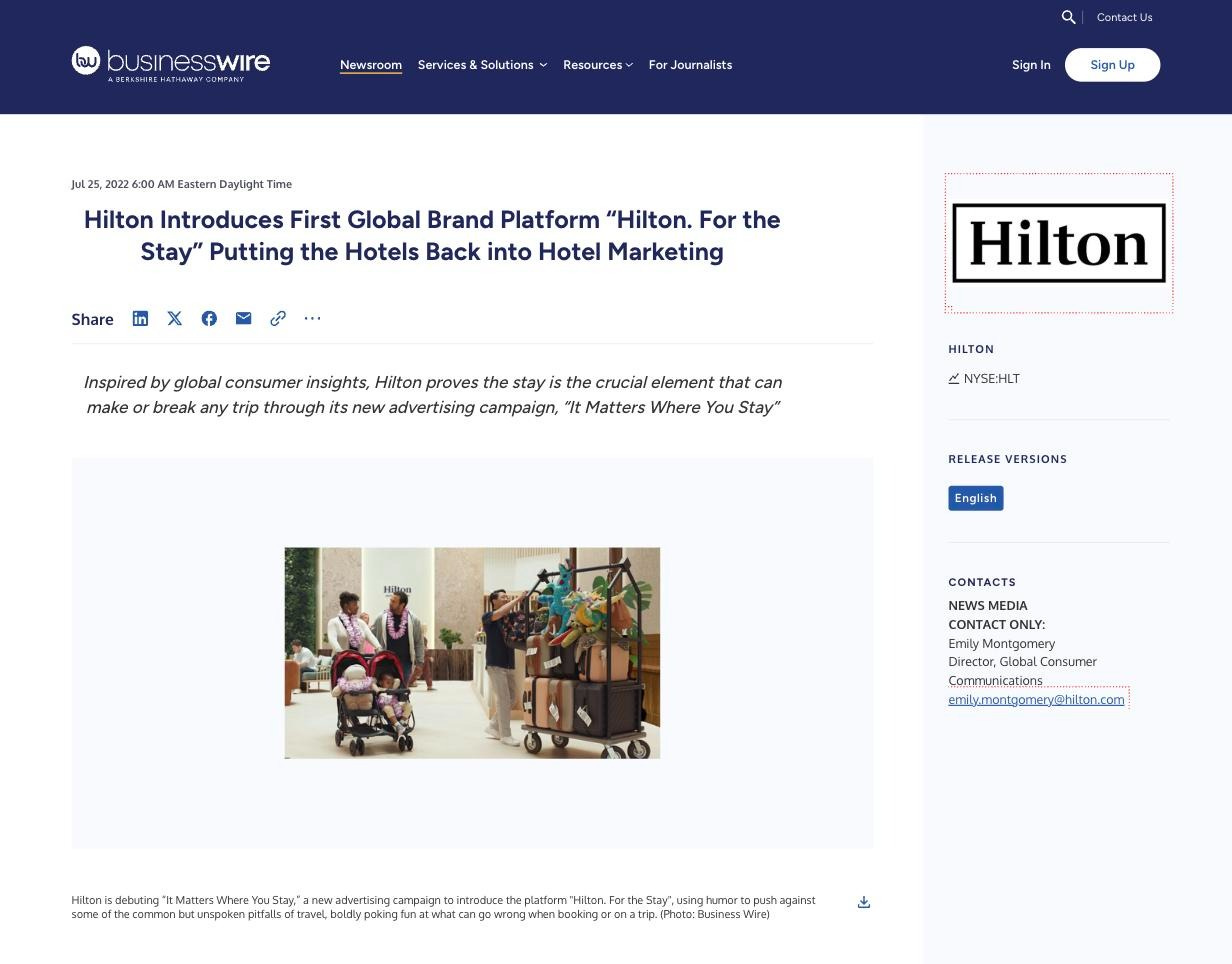
Hilton’s first global brand platform, July 2022
And it kept growing Hilton Honors, its loyalty program: roughly 133M members when the pl››atform launched, more than 243M by the end of 2025. Members who book direct can earn points and use the app to pick a room, check in and unlock the door. That gives people reasons to come back to Hilton before, during and between trips.
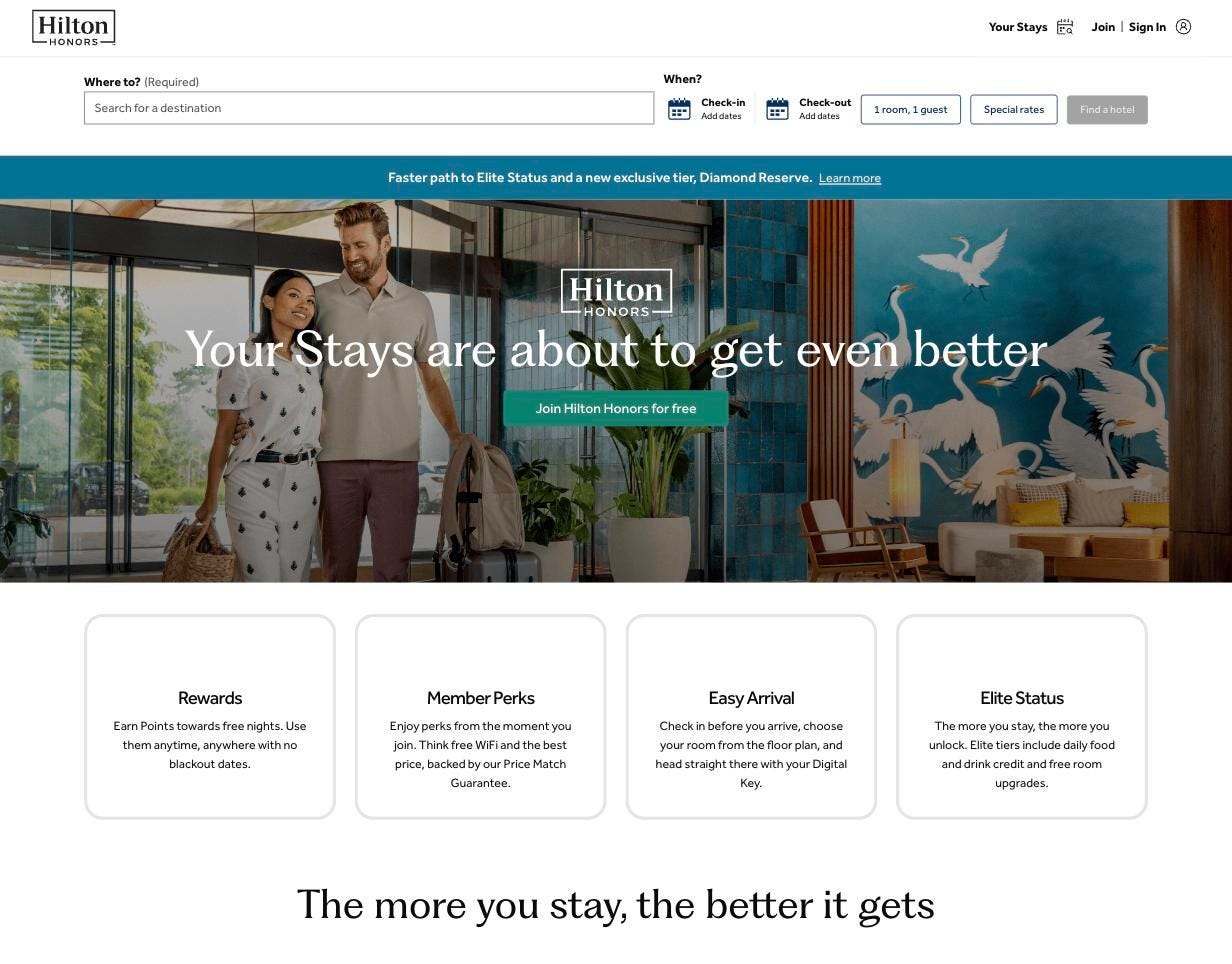
Hilton Honors: 133M members in 2022, 243M by the end of 2025
Types of branded searches and prompts:
In Classic Search, I reviewed 21,543 keywords for hilton.com:
What’s noteworthy is that these searches cover more than trying to find a hotel. Some people are choosing where to stay, while others are buying points, logging in or trying to get online once they’re there.
In AI Search, I reviewed 865 different prompts for hilton.com:
Look at the Cincinnati example. Hilton Garden Inn is already in the prompt. The question is which property makes sense for a family which is interesting because it’s the point Borko was making: get the traveler to name your brand in the request.
But check out the booking-site comparison too. Wanting to stay at a Hilton doesn’t mean someone has decided to book with Hilton. They’re comparing prices across travel sites, so intermediaries still have a chance to get the booking.
Types of backlinks:
What I find interesting here is that Hilton gives other sites something relevant to their own audiences. DoubleTree’s cookie brings it into food content, Honors gives publishers benefits to explain and compare, McLaren partnership puts it in front of motorsport fans, and it gives event organizers a venue, or at least an easier way to get attendees to the event. That gives the brand opportunities to be encountered even when people aren’t necessarily looking for a hotel.
Action items inspired by Hilton that you might consider for your travel brand
Look at what people want to do with your brand. For example, someone looking for a hotel needs something different from someone trying to log in or use the Wi-Fi. Make sure you’ve got the right page for each, and measure whether it helps them finish the job.
Give travelers a reason to take action with your brand. The booking-site comparison prompt shows that someone can choose your brand and still shop around for where to take action. Make the benefits of using your travel product easy to understand.
Leverage the things people remember about your brand. DoubleTree took the cookie from the check-in desk and put the recipe online. That gave food publishers something to cover and a Hilton page to link to. Think about what your own brand has that people might want to share or come back for.
Make it easy for other sites to mention and send people to your brand. A loyalty guide explaining your points and a conference sending people to a specific destination need different pages to link to. Give publishers and partners the right destination, then make sure the traveler can finish what they came to do.
Booking.com - OTA
Brand demand +62%, Classic Search traffic −6%, AI visibility 52 → 62.
What it did: ran ads during four consecutive Super Bowls, from 2022 to 2025, as part of its ongoing Booking.yeah brand campaign. The ads featured well-known U.S. celebrities Melissa McCarthy in 2023, Tina Fey with Glenn Close and Jane Krakowski in 2024, and Kermit and Miss Piggy in 2025, showing the different kinds of stays people could book. To put the advertising opportunity in perspective, the 2025 Super Bowl averaged 127.7 million U.S. viewers. The 2025 campaign also ran across TV, streaming and social media. Its announcement also highlighted free cancellation as a reason to use Booking.
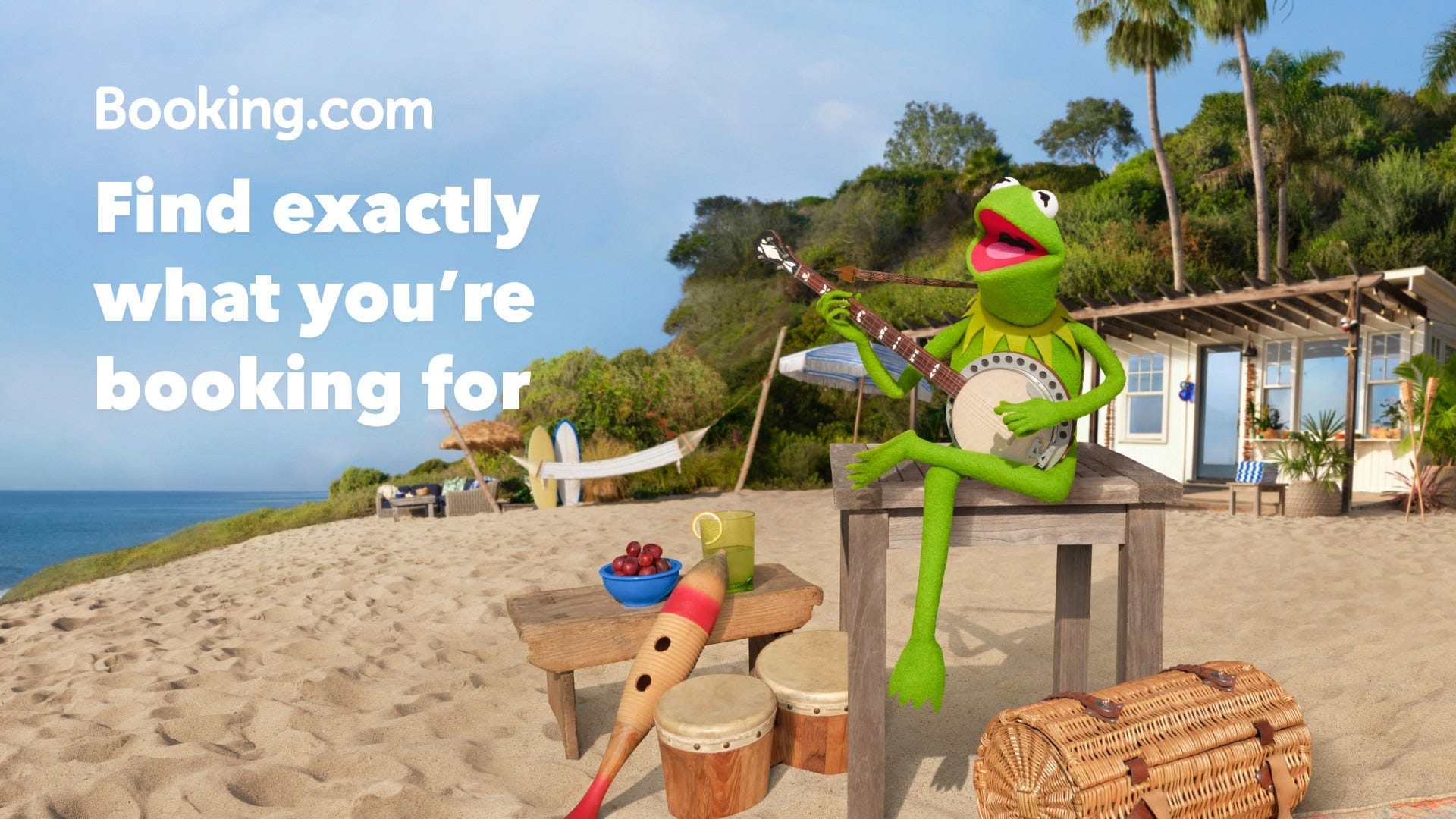
Booking.com’s 2025 Super Bowl campaign with Kermit. Image: Booking.com.
Then there’s Genius, Booking’s free loyalty program, with benefits on selected stays and rental cars. Here you might be wondering: how does an OTA offer such benefits when it doesn’t provide the hotel stay or rental car? Participating suppliers offer discounts and upgrades to help attract bookings, and Booking.com brings the audience and runs the membership program, with higher levels tied to completed bookings. It can also fund some discounts itself, as explained in its program terms. So suppliers can provide the benefits while travelers build their membership with Booking.com. That gives travelers a reason to choose the OTA again, even when their next hotel stay or car rental is with a different supplier.
And Booking also became a ChatGPT apps launch partner in October 2025. Google also recently named it among the partners for its U.S. hotel-booking rollout in AI Mode. These integrations create new ways for Booking to appear inside AI tools. They could contribute to visibility, but this data doesn’t isolate their effect. Google’s August 2026 rollout also came too late to explain the earlier gains.
Classic Search traffic is the one layer where Booking slipped, down 6%, though over the same period most other OTAs lost a fifth or more of theirs. And it’s the only intermediary whose AI visibility grew.
Behind the scenes Booking also has a testing culture. At one point, it was running about 25,000 experiments a year, roughly 1,000 at any moment, and has even published a study of about 150 machine-learning models it has run, including ones that estimate how flexible you are on dates, location and price and whether you’re shopping for a family trip or a work trip, which feed what it shows you.
Types of branded searches and prompts:
In Classic Search, I reviewed 6,082 branded keywords for booking.com:
I noticed that Genius appeared in 47 different keywords, including “booking genius,” “booking genius discount” and “booking genius levels,” so it looks like there are a lot of people just interested in searching for Booking’s loyalty program and how it works. And the Chicago, flight and car-rental searches in the table pair the brand with a trip need.
I find the cancellation searches interesting too because someone checking “booking.com cancellation policy” may be deciding whether they’re comfortable booking in the first place. Personally, free cancellation was one of the things that first drew me to Booking.com, before I was even employed by Booking Holdings. The terms depend on the property and rate, but being able to find those options easily is still one of the reasons I, and I suspect a lot of other people, keep going back.
In AI Search, I reviewed 610 different prompts about Booking:
The payment and trust examples here are interesting as they’re about booking through Booking.com itself: how payment works and whether the platform can be trusted. That makes me think about the free-cancellation example before because it shows how an intermediary can give travelers a reason to choose its brand through the terms and reassurance it can offer around the booking, even when another brand provides the actual product and/or service you get in the end.
Types of backlinks:
These mentions and links put Booking.com in front of people reading travel news, looking for ways to save and planning a trip. Genius gives publishers a benefit to explain and the research and destination recognition give them stories to tell. Then there’s the affiliate links that add a commercial reason to send readers to the platform.
Action items inspired by Booking.com that you might consider for your travel brand
Use big events to get your brand noticed. Booking.com made the Super Bowl a recurring part of its U.S. advertising. Find the sporting events, festivals or cultural moments your travelers care about, and plan relevant campaigns, partnerships or useful content around them.
Build a repeat-use benefit with your partners. If you’re an intermediary, test a member perk with a booking partner. Agree who funds and delivers it, and how you’ll confirm qualifying bookings - even when checkout happens elsewhere.
Turn your customer knowledge into useful stories. Booking.com’s travel research gives publishers something to cover. Use your own data to answer a question their readers care about, and explain how you reached the findings.
Promote the benefits customers come back for. Ask repeat customers why they choose you again, and check reviews for recurring answers. Feature those benefits in your campaigns and onsite content.
Skyscanner - Metasearch
Brand demand +36%, Classic Search traffic +82%, AI visibility 84 → 63.
What it did: invested in U.S. brand awareness alongside its search tools and content. During the 2024 NBA playoffs, its Trollboards campaign put “Dallas to Cancun” on a billboard near the Clippers’ arena in Los Angeles. The joke was that the Mavericks might soon be out of the playoffs and heading on vacation. ESPN and Sports Illustrated picked it up, and it did this without an official NBA partnership. The joke put a specific flight route right beside the Skyscanner name, giving fans a concrete trip to associate with the brand.
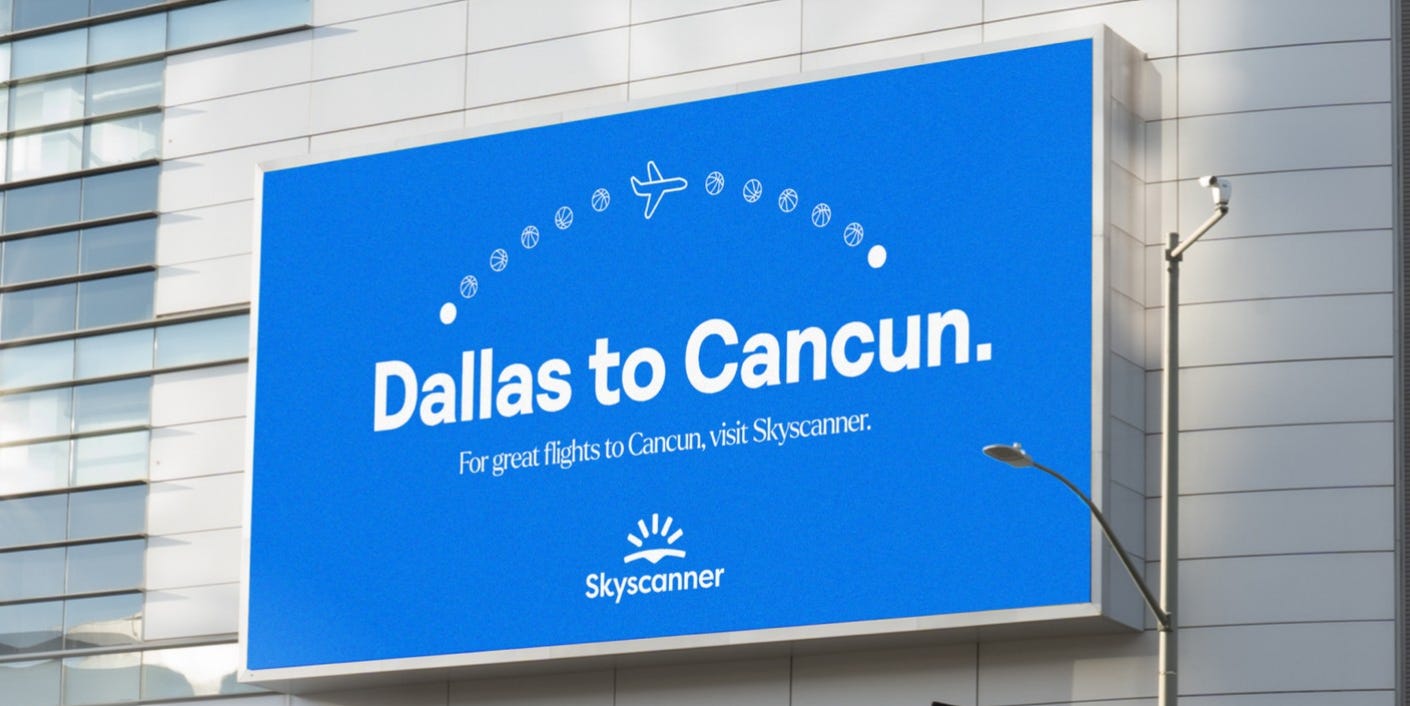
Skyscanner’s “Dallas to Cancun” billboard near Crypto.com Arena in Los Angeles, 2024. Image: Skyscanner, via the Scottish Design Awards.
The promotion continued in 2026. In January, its Director of Americas joined a nationwide media tour promoting its Cheapest Destination Planner. By July, a billboard at San Juan’s airport was drawing on a viral Puerto Rico song to encourage arriving travelers to compare flights next time. Both linked the Skyscanner name to a practical reason to use it.
Alongside all of this branding, it has continued to expand its landing pages around specific travel needs, from flight routes and destinations to hotels, car rentals and flight advice. The keywords it ranked for in the U.S. grew from 905K to 2.6M between February 2023 and August 2026. Its Southwest baggage guide drew about 45K estimated monthly U.S. organic visits in August. The guide gives travelers a place to check what Southwest’s changing baggage rules mean for their trip.
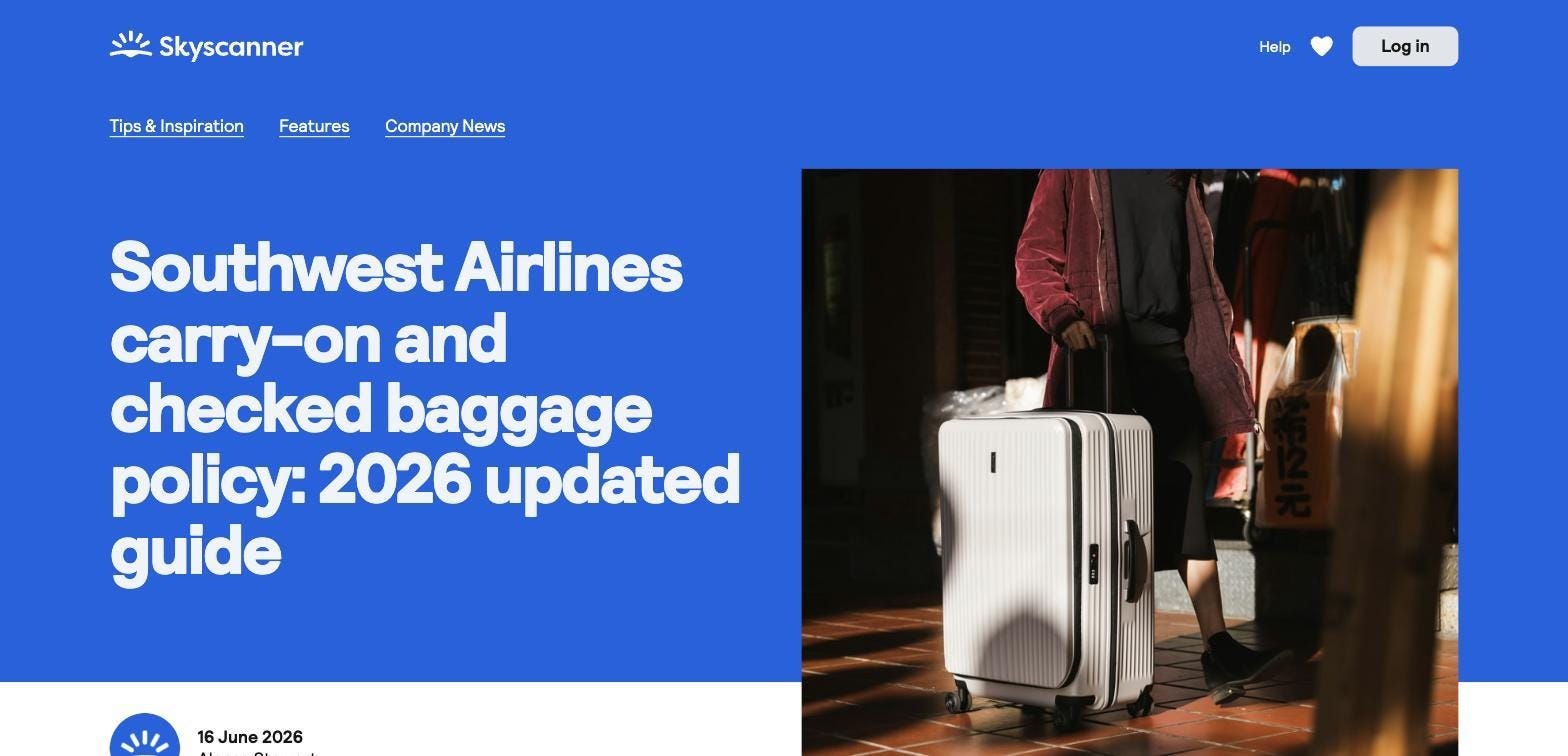
Skyscanner’s Southwest baggage guide, updated June 2026.
Then there’s Skyscanner’s Price Alerts feature which works on both its website and app, giving travelers a reason to return when prices change. What’s more interesting about the app specifically is Drops, which refreshes daily with flights priced at least 20% below their lowest price over the previous seven days. That gives the brand a reason to be checked even before someone has a particular trip in mind. Separately, they offer a Savings Generator tool which uses historical prices to suggest when to book and show average monthly prices.
AI visibility is the one layer where Skyscanner fell, from 84 to 63, but so did every other metasearch brand analyzed, and every OTA except Booking.com, so this looks like a category-wide slide rather than something specific to Skyscanner. Its ChatGPT app launched in February 2026, when its AI visibility score was 69. By August, it was 63. The score doesn’t show a lasting lift after launch, but it doesn’t isolate the app’s effect either. Skyscanner’s gains are a brand-demand and Classic Search story, not an AI one.
Skyscanner has a testing culture behind the scenes too. It built its own experimentation platform, Dr Jekyll, and has run more than 1,100 SEO split tests on its landing pages with SearchPilot, an enterprise-level SEO A/B testing platform.
Types of branded searches and prompts:
In Classic Search, I reviewed 1,106 branded keywords for skyscanner.com:
The flight, car rental and hotel searches show that people associate the name with several parts of a trip. Flights lead among these product examples, but car rental demand is substantial too. That gives Skyscanner more opportunities to be useful, plus the app and Price Alert searches point to features that can keep the relationship going while someone plans.
In AI Search, I reviewed 216 different prompts for skyscanner.com:
Explore Everywhere is noteworthy because you don’t even need a destination in mind to use it. You enter your departure airport and dates, and Skyscanner shows destinations ordered by flight price.
The prompt names the actual feature, just as the Savings Generator example does. That’s interesting in the context of brand: these tools have names of their own within Skyscanner. A traveler has something specific to remember and search for again, beyond the company name.
The Salt Lake City prompt is about tracking a price before booking, so Skyscanner can send price updates while someone is still deciding. For a metasearch brand, these tools offer something useful to come back for during planning, even though the booking happens somewhere else.
Types of backlinks:
The airport example is especially interesting for a metasearch brand. Skyscanner sends people elsewhere to book, yet an airport sends them to it for flight status. There’s a role for the brand after the sale too, alongside the tools and research that get it recommended during planning.
Action items inspired by Skyscanner that you might consider for your travel brand
Pair your brand name with the trip you want people to find. In your campaigns, put a specific route, destination or experience alongside your name, as Skyscanner did with “Dallas to Cancun.” Make it clear what travelers can come to you for.
Build useful tools people can return to by name. Help travelers explore destinations or keep track of prices while they plan. Give those tools clear names and use them consistently across your product and marketing.
Help travelers make sense of industry changes. When baggage fees, booking rules or other policies change, explain what travelers need to know and keep that advice current. Skyscanner’s Southwest guide is an example.
Stay useful after the booking. Look for something travelers still need from you, such as flight updates or help preparing for departure. For intermediaries, that can keep the relationship going after someone books elsewhere.
For some contrast now, let's look at one more brand: earlier, I said there'd be more on Tripadvisor, the brand with the most Classic Search traffic in the analyzed set and far less brand demand driving that.
The flip side: Tripadvisor - Metasearch
Brand demand −9%, Classic Search traffic +2%, AI visibility 59 → 45.
Tripadvisor still had the most Classic Search traffic among the 20 analyzed brands in August, 94M estimated U.S. visits, about half of what it was a year earlier (Semrush), with brand demand at about a fifth of Expedia’s (Google Trends). The +2% above compares full-year averages, so it smooths over that recent drop. Searches for the name itself, “tripadvisor” and its different spellings, bring in about 2M of those visits, around 2%. The other 98% is people searching for a restaurant, a hotel, an attraction, an airline or a destination, not for Tripadvisor. Its biggest page is /Restaurants at 2.5M, most of it from “restaurants near me” and variations of that, and behind it there’s a very long tail: city pages for restaurants, hotels and things to do, and the review pages for individual restaurants, hotels, airlines and attractions.
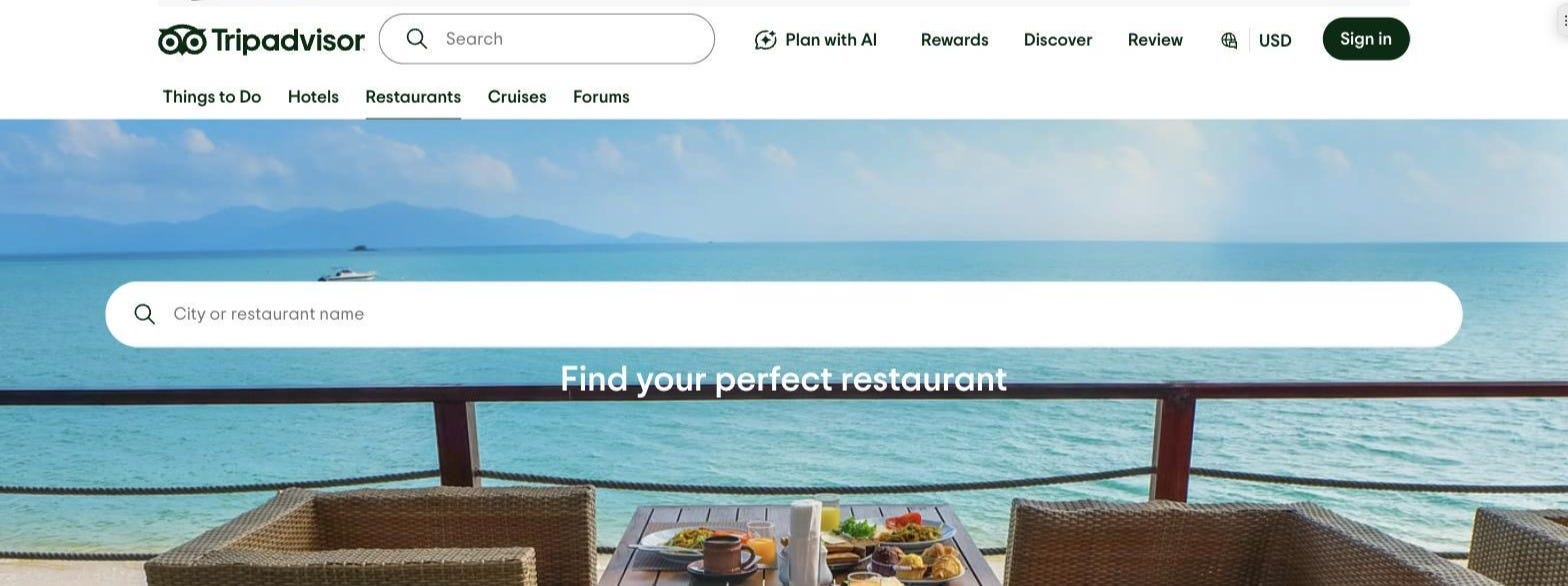
Tripadvisor’s /Restaurants hub: its biggest page at 2.5M a month, most of it from “restaurants near me” searches.
Google sends people in, they read, they leave, and almost nobody needs to type “Tripadvisor” to get there. That’s the kind of visit Google now answers on the results page itself, and Tripadvisor’s CEO said so in February: “ongoing declines in ‘fly by’ visitors to our site due to the changing search landscape, including the rise of AI overviews.”
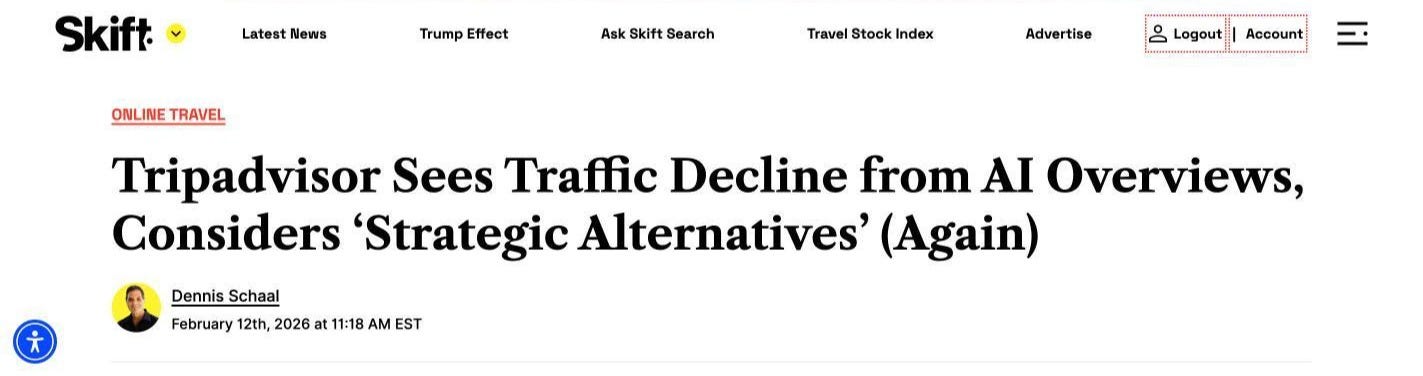
Skift, February 12, 2026: Tripadvisor’s CEO on declining “fly by” visitors as the search landscape changes, including AI Overviews.
Tripadvisor’s Hotels & Other revenue fell 21% year over year in Q2 2026, although that number doesn’t say how much of the decline AI caused.
There’s a real audience in there, though. The same remarks highlighted a stable base of travelers who shared nearly 80 million reviews, photos and forum posts last year despite the traffic headwinds. So I think the question worth exploring here, for Tripadvisor and for any brand living on non-branded SEO traffic, is how many of those visitors actually come back by choice next time, and what could be done to encourage and reward more of them for doing it.
Free Claude skill for subscribers: brand-signal-reader
Before we wrap up, if you’re interested in efficiently pulling keyword, prompt and/or backlink insights and potential action items for your brand (or for another brand you’re benchmarking against) in a format similar to what I’ve done for the brands above, I’ve created a Claude skill called brand-signal-reader that can save you about an hour or more of work (as it already asks the right questions). You can have it, it’s right here, free for subscribers.
🎮 Play this essay
One more thing before we wrap up. For fun, I asked myself: what if you could play this essay as a video game instead of reading it? So I turned the whole argument into a five-minute game, because why not.

You run a travel brand on a small island, meet three travelers, make three choices, and based on those choices you find out whether people end up searching for your brand name or not.
If this topic resonated with you and you want to have a little fun with it, you can play it right now in your browser, desktop or mobile. No sign-in, nothing gated: play.travelsearchpulse.com
🏝️ Where we’ve ended up
Rank the travel brands analyzed by brand demand, and their Classic Search traffic and AI visibility mostly follow. Suppliers sit on top of both, and the two brands that grew across all three layers invested in loyalty and in marketing their brands. That doesn’t directly prove brand demand drives SEO or GEO performance, but it points in that direction and strengthens my view that building trust and demand for your brand is a solid foundation for growing your business through Classic Search and AI Search. And the Tripadvisor example shows why this matters: a huge audience from non-branded search doesn’t automatically turn into people looking for your brand by name.
Why might brand demand be so important here? Let’s consider it from the traveler’s perspective: for the traveler, a brand is about trust. When you’ve got a bunch of sites you’ve never heard of selling the same flight, scam travel sites, and spam in your messages and across social media, when there’s that much noise, you tend to go back to what worked for you last time. I don’t think it’s complicated: I booked with them, it went well, so I’ll type their name in next time. It’s the memory of a satisfying experience, and it shows up in the search bar or address bar as someone typing your brand name.
So do more to get your brand out there, help the traveler get something done when they land on your site, give them a reason to come back, and on top of that you can build stronger, more resilient Classic Search and AI Search performance that drives revenue.
Carville’s “It’s the economy, stupid” line stuck because underneath all of the political noise, it provided a very clear signal and a simple truth: people just wanted a leader who would enable and protect their ability to work and live their lives. Underneath all of the noise in search right now, the traveler just wants a name they can trust to get them where they’re trying to go.
It’s the brand, stupid. 🙂
If you want to talk brand demand and SEO, or just travel and SEO/GEO in general - hit me up, I do answer 😌.
P.S. Shout out to Kevin Indig. The shape of this essay owes a lot to Kevin’s Growth Memo, which inspired me to start writing about travel SEO. Kevin once sent me one of his paid deep dives on the travel industry, and it stuck with me as the way a data essay for one industry should look. Thanks man!